Save on Grass Removal, Xeriscaping, and Water-Wise Landscaping in Arizona
Arizona homeowners may qualify for landscaping rebates worth hundreds or thousands of dollars when replacing existing lawns with water-efficient landscaping. Cities throughout the Phoenix metropolitan area offer incentives for grass removal, xeriscaping, desert-adapted plants, and irrigation improvements.
However, not every artificial turf installation or landscaping project qualifies for a rebate. Some cities allow synthetic grass as part of an approved landscape conversion, while others exclude artificial turf from the square footage used to calculate the rebate.
Eligibility also depends on existing grass conditions, municipal water service, plant coverage requirements, application deadlines, and available program funding.
This 2026 guide compares Arizona landscaping rebate programs in Phoenix, Chandler, Gilbert, Mesa, Scottsdale, Tempe, and Queen Creek. It explains how to determine whether your yard qualifies, estimate potential savings, and prepare your landscaping project for municipal approval.
Important: Do not remove existing grass before receiving any required municipal approval or Notice to Proceed. Beginning construction before authorization can disqualify an otherwise eligible project.
Can Your Arizona Landscaping Project Qualify for a Rebate?
Different landscape designs may qualify for different incentives. Use the following comparison to determine which programs deserve a closer look before planning your project.
| City |
Grass to Xeriscape |
Mixed Design With Artificial Turf |
Artificial Turf Only |
| Phoenix |
Potentially eligible |
Some turf permitted; city reviews the design |
Confirm eligibility with city |
| Chandler |
Potentially eligible |
Artificial turf area excluded from rebate |
Not eligible |
| Gilbert |
Potentially eligible |
Confirm current program requirements |
Do not assume eligibility |
| Mesa |
Potentially eligible |
Allowed with required living plant coverage |
Not eligible |
| Scottsdale |
Confirm current program availability |
City approval required |
Do not assume eligibility |
| Tempe |
Potentially eligible |
Living plant coverage requirements apply |
Not eligible for full-area rebate |
| Queen Creek |
Potentially eligible |
Up to 1,000 sq. ft. of turf with required canopy |
Does not meet plant canopy requirements |
Eligibility is not guaranteed. Each municipality evaluates the existing lawn, proposed conversion, plant coverage, application timing, and available program funding.
Start Here: Does Your Yard Meet Basic Rebate Requirements?
Before ordering landscaping materials or scheduling grass removal, determine whether your property meets the basic qualifications for a municipal incentive.
- Identify your water provider. Check your water bill to determine which municipality or utility supplies your property. Your mailing address does not always determine rebate eligibility.
- Confirm current rebate availability. Application periods, funding limits, and deadlines can change throughout the year.
- Measure your existing grass. Most grass removal incentives require an established, irrigated lawn and a minimum qualifying conversion area.
- Review the proposed landscape design. Identify which areas will contain drought-tolerant plants, artificial grass, decorative rock, pavers, or irrigation.
- Check plant canopy requirements. Several cities require living trees and shrubs to provide a percentage of mature plant coverage.
- Apply before removing grass. Obtain any required pre-inspection, approval, or Notice to Proceed.
What if Your Yard Has No Existing Grass?
Homeowners with newly constructed homes, unfinished dirt backyards, or existing desert landscaping generally cannot qualify for traditional grass removal rebates unless a particular program provides another eligible pathway.
However, some municipalities offer separate water conservation incentives for upgrading qualifying irrigation equipment.
Homeowners starting with bare dirt can still plan an efficient landscape from the beginning using xeriscaping, drought-tolerant plants, and appropriate irrigation systems.
Arizona Landscaping Rebate Amounts by City in 2026
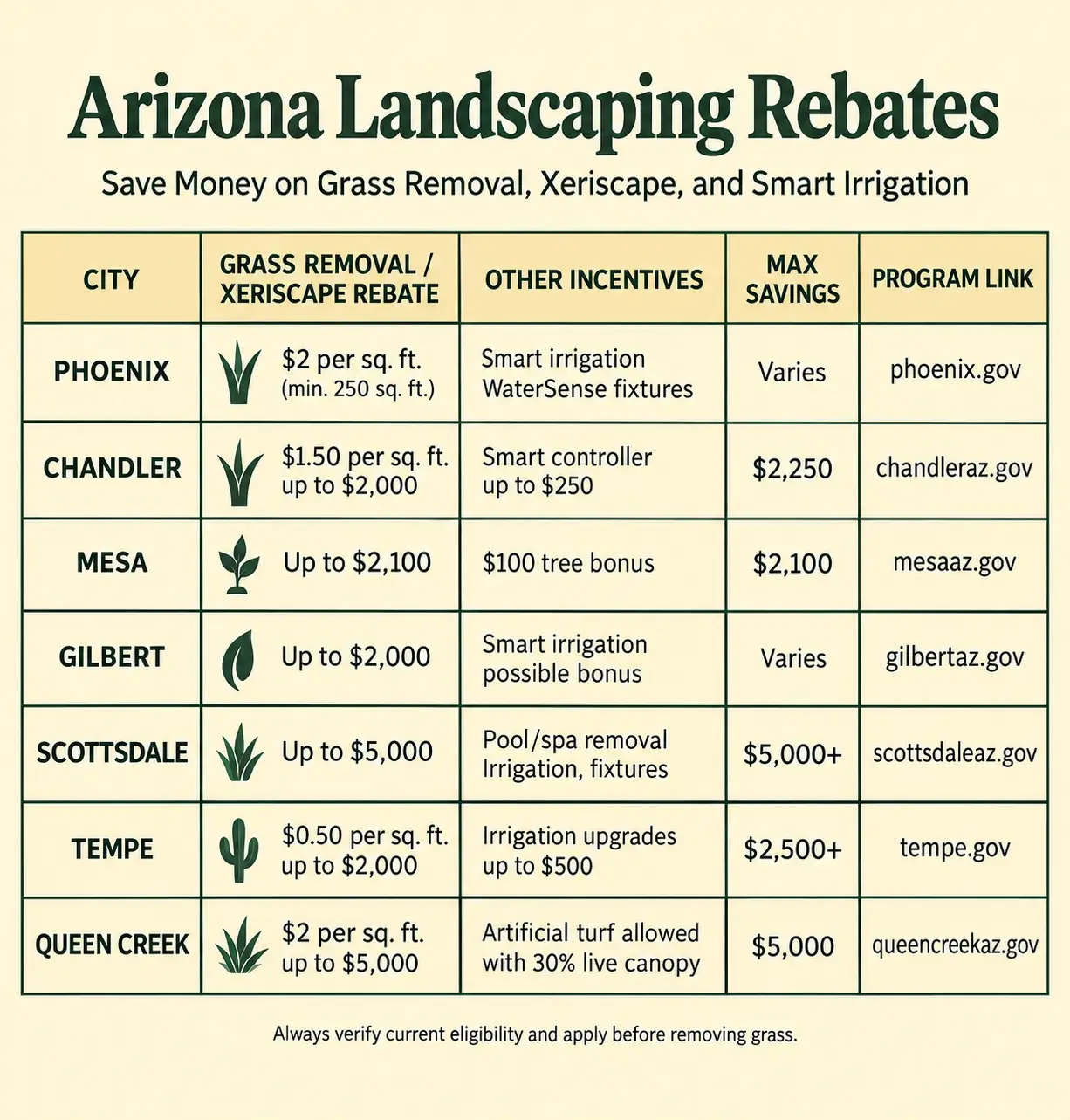
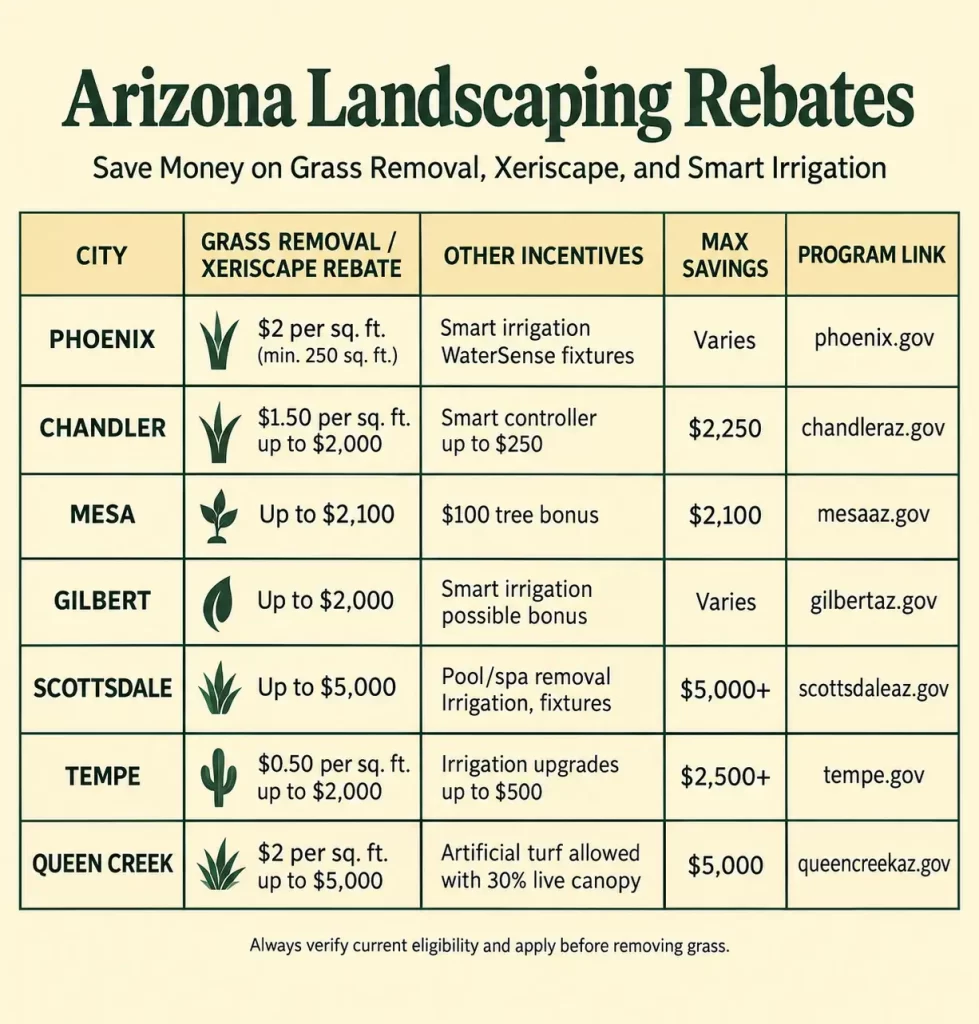
The following table summarizes published residential grass removal and xeriscape incentives across the Phoenix metropolitan area.
| City |
Published Incentive |
Minimum Grass Removal |
Important Condition |
| Phoenix |
$2 per sq. ft. |
250 sq. ft. |
Approval before removal |
| Chandler |
$1.50 per sq. ft.; up to $2,000 |
500 sq. ft., with limited exceptions |
Artificial turf excluded from rebate calculation |
| Gilbert |
Up to $2,000 plus potential $1,000 plant bonus |
See current application |
Bonus requirements apply |
| Mesa |
Up to $2,100 with qualifying trees |
500 sq. ft. |
50% mature canopy coverage |
| Scottsdale |
Up to $5,000; confirm current availability |
See current application |
Pre-inspection required |
| Tempe |
$0.50 per sq. ft.; up to $2,000 |
See current application |
30% mature plant coverage for full-area rebate |
| Queen Creek |
$2 per sq. ft.; up to $5,000 |
500 sq. ft. |
30% plant canopy requirement |
All amounts are subject to municipal approval, eligibility requirements, and available funding. Confirm the current incentive with the water provider before beginning a project.
For additional regional incentives, visit the Arizona Municipal Water Users Association’s rebate directory.
Are There Artificial Grass Rebates in Arizona?
Arizona does not offer a single statewide artificial grass tax rebate covering every residential installation.
Instead, cities and water utilities administer grass removal, xeriscape conversion, and water conservation incentives. These programs focus primarily on reducing irrigation demand rather than simply paying homeowners to install synthetic grass.
Grass Removal Rebates vs. Artificial Turf Rebates
A grass removal rebate rewards property owners for removing eligible existing grass and replacing it with approved low-water-use landscaping.
Some cities allow artificial turf within a qualifying landscape design. However, the artificial turf itself may not count toward the rebate calculation.
- Chandler: Artificial turf areas are excluded from the eligible conversion measurement.
- Mesa: Artificial turf may be incorporated into a qualifying project, but sufficient living plant canopy is required.
- Queen Creek: Up to 1,000 square feet of artificial turf can be incorporated into approved projects that satisfy plant canopy rules.
- Phoenix: Some artificial turf may be permitted within approved desert landscape conversions.
- Gilbert, Scottsdale, and Tempe: Confirm artificial turf eligibility with the municipality before purchasing materials.
Is Artificial Turf a Good Choice for Arizona Yards?
Artificial grass can provide a functional outdoor area without the routine irrigation required by a natural lawn. It can be particularly useful for certain recreational areas and low-maintenance landscape designs.
However, synthetic grass can become extremely hot during Arizona summers. Its placement should account for available shade, drainage, intended use, nearby plants, and existing trees.
A well-designed artificial turf installation can incorporate complementary desert plants and hardscaping while supporting the property’s overall function and appearance.
Phoenix Grass Removal Rebate Program
The City of Phoenix offers qualifying homeowners $2 per square foot of existing grass removed and replaced with approved low-water-use landscaping.
The program is intended to reduce outdoor water consumption while encouraging sustainable landscape designs suited to the Sonoran Desert.
Phoenix Grass Removal Rebate Requirements
- Remove at least 250 square feet of qualifying existing grass.
- Provide required photographs of the existing lawn.
- Submit conversion-area measurements and supporting documentation.
- Receive approval and a Notice to Proceed before removing grass.
- Install approved water-efficient replacement landscaping.
- Complete the conversion within the city’s authorized timeframe.
Phoenix describes approved desert landscaping plans that can include some artificial turf. Therefore, artificial grass is not automatically prohibited from the finished design.
However, the city must determine whether each proposed conversion satisfies its current requirements.
How Much Could a Phoenix Homeowner Receive?
A homeowner removing 1,000 square feet of qualifying grass could potentially receive:
1,000 sq. ft. × $2 = $2,000.
The actual amount depends on the city’s measurements, approval, and available funding. Projects involving more than 5,000 square feet may receive additional review.
Official program: City of Phoenix Residential Grass Incentives.
Chandler Grass Removal and Water Conservation Rebates
Chandler revised its residential grass removal incentive effective January 1, 2026.
The program now provides $1.50 per square foot of eligible grass converted to xeriscaping, up to $2,000 per property.
This replaces Chandler’s previous $2-per-square-foot incentive with a $3,000 maximum.
Chandler Grass Removal Eligibility
Qualifying applicants must have an active Chandler water utility account and eligible existing grass.
Major program requirements include:
- At least 500 square feet of qualifying grass removal, subject to limited city-approved exceptions.
- Existing living grass that meets the municipality’s eligibility requirements.
- Replacement landscaping with approved low-water-use plants.
- Applicable 50% mature plant canopy coverage requirements.
- Required photographs and official conversion measurements.
- A Notice to Proceed before construction.
- Project completion within 90 days of authorization unless the city approves an extension.
Flood-irrigated areas are ineligible under Chandler’s published policy.
Does Chandler Offer an Artificial Turf Rebate?
No. Areas converted to artificial turf are excluded from Chandler’s grass removal rebate calculation.
A homeowner may incorporate synthetic turf into other portions of the finished landscape, but only the qualifying xeriscape conversion area can be counted toward the incentive.
The city’s verified grass removal measurement determines the eligible area. Contractor material orders may include additional artificial turf for cutting, fitting, and installation waste, but these quantities do not increase the rebate.
How Does Chandler Pay the Rebate?
After final approval, Chandler applies the approved rebate as a credit to the property’s utility services account.
Homeowners should not assume the incentive will reduce their contractor’s original invoice.
Chandler also offers separate rebates for qualifying smart irrigation controllers, potentially providing up to $250 toward eligible equipment.
Official sources:
Homeowners planning a complete renovation can explore Chandler landscape design services to incorporate drought-tolerant plants, irrigation, and functional outdoor areas.
Gilbert Grass Removal Rebates and Desert Plant Incentives
The Town of Gilbert provides residential water conservation incentives designed to encourage homeowners to replace existing grass with low-water-use landscaping.
Gilbert advertises up to $2,000 for qualifying grass removal, plus a potential additional $1,000 desert plant bonus.
Receiving the additional incentive is conditional. Homeowners should verify its current eligibility and documentation requirements before including the bonus in their project budgets.
What Should Gilbert Homeowners Check Before Applying?
- Whether the property receives qualifying Gilbert water service.
- The minimum eligible grass removal area.
- Existing grass condition requirements.
- Approved desert plants and landscape materials.
- Artificial turf eligibility and limitations.
- Application and inspection requirements.
- Current funding availability.
Gilbert also offers separate incentives for selected water conservation improvements, including qualifying smart irrigation controllers.
Applicants should confirm the town’s current program requirements and available funding before starting work.
Official program: Gilbert Water Conservation Rebates.
Explore landscape design services in Gilbert for complete outdoor renovations incorporating low-water-use plants, functional landscaping, and efficient irrigation.
Mesa Grass-to-Xeriscape and Tree Bonus Program
Mesa offers residential incentives of up to $2,100 for qualifying grass removal projects that replace existing lawns with approved low-water-use landscaping.
Unlike a flat per-square-foot rebate, Mesa uses a tiered payment structure based on the amount of eligible grass removed.
Mesa Xeriscape Rebate Amounts
| Grass Removed |
Base Rebate |
With Two Qualifying Trees |
| 500–999 sq. ft. |
$1,000 |
$1,100 |
| 1,000–1,499 sq. ft. |
$1,500 |
$1,600 |
| 1,500+ sq. ft. |
$2,000 |
$2,100 |
Mesa Grass Removal Rebate Requirements
- At least 500 square feet of qualifying existing grass.
- Required photographs and pre-project approval.
- Replacement landscaping using approved low-water-use plants.
- At least 50% mature plant canopy coverage in the grass conversion area.
- Approved landscape mulch and planting materials.
- Completion within six months of receiving authorization.
Mesa generally excludes recently constructed homes built within one year of the application date.
Can Mesa Homeowners Install Artificial Turf?
Yes. Mesa permits artificial turf within certain qualifying landscape conversions.
However, a conversion consisting only of artificial grass does not qualify.
The replacement landscape must include approved living plants providing at least 50% mature canopy coverage of the grass removal area.
Mesa provides an online plant calculation resource to help homeowners estimate coverage based on approved plant selections.
Official resources:
Learn more about Mesa landscape design services for backyard renovations that combine trees, drought-tolerant plants, hardscaping, and irrigation.
Scottsdale Grass Removal and Water Conservation Rebates
Scottsdale publishes residential grass removal incentives of up to $5,000 for qualifying conversions.
However, homeowners should confirm the current program status before planning construction.
Important Scottsdale Rebate Availability Notice
Scottsdale’s published residential rebate information contains older language describing a previously closed grass removal program, while its updated application table lists an October 31, 2026 deadline.
Because these notices are not fully reconciled, homeowners should verify whether applications are currently being accepted and whether funds remain available.
Contact Scottsdale Water Conservation at 480-312-5650 before beginning grass removal.
Scottsdale Grass Removal Requirements
Qualifying projects may require:
- Existing eligible grass.
- Current program application and approval.
- Pre-removal inspection.
- Official conversion area measurements.
- Approved replacement landscaping.
- A Notice to Proceed before removing grass.
- Completed project documentation and final verification.
Additional Scottsdale Water Rebates
Scottsdale also publishes separate residential incentives for qualifying improvements, including:
- WaterSense smart irrigation controllers: up to $250.
- Eligible pool removal: up to $1,500.
- Smart home water monitors: up to $100.
Each incentive has separate program conditions and funding requirements.
Official program: Scottsdale Residential Water Conservation Rebates.
Explore Scottsdale landscape design services for renovations incorporating shade, water-wise planting, and functional outdoor living spaces.
Tempe Grass Removal and Water Conservation Rebates
Tempe offers residential grass removal incentives of $0.50 per square foot of qualifying grass converted to desert landscaping, up to $2,000 per home per fiscal year.
Its program is designed to encourage low-water-use landscapes while reducing the amount of irrigated grass across residential properties.
Tempe Grass Removal Eligibility
Homeowners should apply before beginning construction and obtain the required authorization.
For a rebate covering the full converted area, the finished landscape generally must include at least 30% expected mature living plant coverage.
Conversions with less plant coverage may be considered for a reduced eligible area under the city’s specific requirements.
Replacing grass with bare soil alone does not qualify.
Other Tempe Landscaping and Irrigation Rebates
- High-efficiency irrigation: Up to $500 for qualifying improvements to existing irrigation equipment.
- TreeBate: Up to $75 for eligible low-water-use plants.
- Gray water systems: Up to $200 for approved household water-reuse improvements.
Homeowners should review the individual incentive requirements to determine whether their proposed work qualifies.
Official sources:
Queen Creek Turf Conversion Incentive Program
Queen Creek announced a residential turf conversion incentive in June 2026, providing eligible water customers with $2 per square foot of qualifying grass removed, up to $5,000 per property.
The program requires at least 500 square feet of qualifying grass removal.
Queen Creek Grass Removal Requirements
- Qualifying property within the town’s water service area.
- At least 500 square feet of existing eligible grass.
- Approved low-water-use replacement landscaping.
- Required project documentation and authorization.
- Compliance with plant canopy requirements.
- Completion and final verification under the current program rules.
Does Queen Creek Allow Artificial Turf?
Yes. Queen Creek permits artificial turf in qualifying landscape conversions, subject to specific limitations.
Under the published program, synthetic grass can cover up to 1,000 square feet while the finished landscaping must achieve at least 30% required plant canopy density.
This allows homeowners to incorporate usable artificial grass areas while maintaining living desert-adapted plants.
A project using only synthetic grass without the required living canopy would not satisfy the plant coverage requirement.
Official source: Queen Creek 2026 Turf Conversion Incentive Announcement.
Explore Queen Creek landscape design services for complete outdoor renovations incorporating desert landscaping, artificial turf, and hardscaping.
What Do 30% and 50% Mature Plant Canopy Requirements Mean?
Several Arizona landscaping rebate programs require a minimum percentage of living plant coverage.
However, mature plant canopy coverage is not necessarily the same as planting bed square footage or the size of plants when installed.
Municipalities may calculate canopy using the anticipated mature size of qualifying trees, shrubs, and other approved plants.
Example: A 1,000-Square-Foot Landscape Conversion
Suppose a program requires 50% mature plant canopy coverage across an approved 1,000-square-foot calculation area.
The target would be:
1,000 sq. ft. × 50% = 500 sq. ft. of qualifying mature plant coverage.
That coverage might come from a combination of shade trees, flowering shrubs, and smaller desert-adapted plants.
However, the calculation does not necessarily require installing 500 square feet of planting beds.
How Cities Calculate Plant Canopy
Municipal requirements can vary regarding:
- Whether canopy is calculated using the original grass removal area or a larger landscaped area.
- Which plants qualify under the approved plant list.
- How mature plant sizes are determined.
- Whether existing trees count toward the requirement.
- How overlapping plant canopies are treated.
- Whether artificial turf affects the calculation.
For example, Mesa calculates its mature canopy requirement within the approved grass conversion area, while Chandler’s policy references the applicable landscapable area.
Choosing Appropriate Desert Plants
Arizona landscape designs commonly incorporate palo verde, desert willow, mesquite, Texas sage, red yucca, and other drought-tolerant plants.
Plant selection should account for mature size, irrigation needs, available space, root development, and HOA restrictions.
Rather than relying on generic canopy measurements, homeowners should use the municipality’s accepted plant list or official calculator.
For planting guidance, explore Landscape Plants for the Arizona Desert from AMWUA.
Arizona Construction Details That Can Affect Your Rebate Project
Municipal requirements are only one part of planning a successful landscape conversion.
Arizona’s extreme heat, existing trees, irrigation systems, and neighborhood restrictions can influence the finished design.
Protect Existing Trees During Grass Removal
Mature trees may depend on the irrigation that previously supplied water to an existing lawn.
Removing grass without adjusting irrigation can create moisture stress, particularly during Arizona’s hottest months.
Installing artificial turf or compacting soil around sensitive tree root zones can also change soil moisture, temperature, and oxygen availability.
Homeowners should evaluate existing trees before removing grass or changing nearby landscaping.
Preserving root zones, maintaining appropriate irrigation, and selecting suitable surrounding materials can help protect established trees.
No single artificial turf setback is appropriate for every tree species, age, or property condition.
Convert Irrigation to Match Your New Landscape
Traditional lawns often use pop-up sprinkler heads and frequent watering schedules. Desert-adapted trees, shrubs, and planting beds generally require a different irrigation approach.
A landscape conversion may involve:
- Properly deactivating unused lawn sprinkler heads.
- Installing appropriate filtered and pressure-regulated drip irrigation.
- Separating irrigation zones by plant water needs.
- Adjusting schedules for trees and established shrubs.
- Using smart irrigation controllers where appropriate.
- Ensuring new planting areas receive adequate water during establishment.
These upgrades can improve irrigation efficiency and may help homeowners meet the requirements of applicable water conservation incentives.
Explore Platinum Outdoors’ irrigation installation services when planning a complete landscape renovation.
Understand HOA Restrictions Before Designing Your Landscape
Many Phoenix-area neighborhoods and East Valley master-planned communities have architectural and landscaping standards administered by homeowners associations.
An HOA may restrict certain tree species, mature heights, landscaping materials, or planting locations near streets and property boundaries.
At the same time, municipal rebate programs may require a percentage of living plant canopy.
These requirements can create conflicts if a homeowner designs a landscape around city rebate eligibility without first reviewing HOA restrictions.
Before construction, obtain any required HOA approval and make sure the HOA-approved design matches the plan submitted to the municipal rebate program.
Municipal rebate approval does not replace HOA authorization or applicable construction permits.
How Much Could Your Arizona Landscaping Rebate Save?
The total size of a backyard renovation is not necessarily the same as the amount of landscaping that qualifies for a rebate.
Understanding the difference between the eligible conversion area and the finished project area can prevent unrealistic financial expectations.
Example: Chandler Xeriscaping With Artificial Turf
Consider a Chandler homeowner removing 1,200 square feet of existing grass.
The proposed replacement landscaping includes:
- 800 square feet: Qualifying xeriscaping and living desert plants.
- 400 square feet: Artificial turf.
- Total: 1,200 square feet of converted landscaping.
Chandler excludes artificial turf areas from its rebate calculation.
If the city approves the 800-square-foot xeriscape portion, the potential incentive would be:
800 sq. ft. × $1.50 = $1,200.
The homeowner would not receive a $1,800 rebate merely because 1,200 square feet of existing grass was removed.
The actual eligible area and payment depend on the city’s measurements, plant coverage requirements, and final approval.
Understanding Project Cost After a Rebate
Homeowners can estimate their net economic project cost using a straightforward calculation:
Estimated landscaping cost − approved rebate = estimated project cost after incentive.
For example:
| Illustrative Landscape Project |
$15,000 |
| Potential Approved Rebate |
$1,200 |
| Estimated Net Economic Cost |
$13,800 |
These figures are illustrative and are not a Platinum Outdoors construction estimate.
The example also does not mean the homeowner pays only $13,800 during construction.
Some cities, including Chandler, issue approved rebates after project completion through utility-account credits rather than directly reducing a contractor’s invoice.
Potential future water and maintenance savings should be considered separately from the initial rebate.
How to Apply for Arizona Landscaping Rebates
Although application procedures vary by municipality, the following checklist outlines the typical process from planning through final approval.
Before Applying
- Identify your property’s water provider.
- Confirm the rebate program is currently accepting applications.
- Photograph the existing irrigated grass.
- Estimate the proposed grass removal area.
- Review eligible replacement landscaping and plant requirements.
- Determine whether your project requires HOA approval.
- Prepare the initial landscape plan and any requested plant information.
Before Construction Begins
- Submit the required municipal application.
- Provide existing grass photographs and measurements.
- Complete any required pre-inspection.
- Receive the city’s Notice to Proceed or written authorization.
- Confirm the approved conversion area and potential rebate.
- Review the construction completion deadline.
- Ensure the contractor’s proposed scope matches the approved landscape design.
Important: Homeowners should not remove existing grass while waiting for approval if their municipal program prohibits beginning work before authorization.
During and After Installation
- Keep receipts and relevant landscaping documents.
- Photograph the finished grass conversion.
- Retain plant lists and irrigation documentation where required.
- Submit any required completion forms.
- Schedule the municipality’s final inspection when applicable.
- Provide requested tax documentation.
- Confirm the final rebate approval and payment or credit method.
Why Official Measurements Matter
Landscaping contractors may calculate material quantities differently from municipal rebate administrators.
For example, artificial turf orders may include additional material for curves, cutting, seams, and installation waste.
Municipalities generally determine rebates using their approved measurements of existing grass and eligible conversion areas.
Homeowners should therefore rely on the city’s verified measurements rather than the total amount of material purchased.
Can New Construction Homes Qualify for Landscaping Rebates?
Many homeowners in Queen Creek, Gilbert, Mesa, Chandler, and other growing East Valley communities purchase newly constructed homes with unfinished dirt backyards.
These properties are an important exception to traditional grass removal incentives.
A new home with a bare dirt backyard generally does not qualify for a rebate designed to remove existing irrigated grass.
The purpose of these programs is to replace established lawns that already consume water.
Mesa excludes homes built within the year preceding the application date, while Chandler also excludes new construction under its residential grass removal policy.
Nevertheless, homeowners can design water-efficient landscaping from the beginning.
Appropriate improvements may include:
- Desert-adapted shade trees and shrubs.
- Water-efficient drip irrigation.
- Smaller artificial turf areas where appropriate.
- Functional patios and walkways.
- Appropriate landscape grading and drainage.
- Water-efficient planting zones.
Separate irrigation equipment incentives may be available depending on the water provider and whether the proposed installation meets the program’s requirements.
Frequently Asked Questions About Arizona Landscaping Rebates
Does Phoenix offer a grass removal rebate in 2026?
Yes. Phoenix publishes a $2-per-square-foot residential incentive for qualifying grass removal projects. Homeowners must provide required documentation and obtain approval before removing the existing grass.
Is there a statewide artificial grass rebate in Arizona?
There is no single statewide artificial grass tax rebate covering all residential installations under the municipal programs described here. Eligibility depends on individual city or water utility requirements.
Does Chandler still offer $3,000 for grass removal?
No. Under its revised 2026 residential program, Chandler offers $1.50 per qualifying square foot, up to $2,000. Areas converted to artificial turf are excluded from the rebate calculation.
How much does Gilbert pay for grass removal?
Gilbert advertises up to $2,000 for qualifying residential grass removal and a potential additional $1,000 desert plant bonus. Homeowners must verify eligibility for the additional incentive.
Can Mesa homeowners install artificial turf and still receive a rebate?
Potentially. Mesa allows artificial turf within qualifying mixed landscape conversions, but the finished project must satisfy its 50% mature living plant canopy requirement. An artificial-turf-only conversion does not qualify.
Can homeowners receive landscaping rebates for newly constructed homes?
Grass removal incentives generally require existing irrigated grass. Newly constructed homes with unfinished dirt yards typically do not qualify for those specific programs. Separate irrigation efficiency incentives may have different rules.
Do HOA approvals replace city rebate approvals?
No. Homeowners must comply with applicable municipal requirements and HOA restrictions independently. Approval from one does not automatically satisfy the other.
Can homeowners combine grass removal and smart irrigation rebates?
Sometimes. Certain municipalities offer separate incentives for qualifying grass removal and water-efficient irrigation improvements. Each program has its own application rules, limitations, and funding requirements.
Plan Your Water-Wise Arizona Landscape With Platinum Outdoors
Arizona landscaping rebates can offset part of the cost of replacing an existing lawn with approved water-efficient landscaping.
However, the finished outdoor space should remain attractive, functional, and suited to Arizona’s extreme climate long after the incentive has been processed.
Platinum Outdoors designs and builds outdoor spaces throughout Phoenix and the East Valley, including xeriscaping, artificial turf installation, irrigation systems, and complete landscape design and installation.
Our approach considers the property’s layout, intended use, desert-adapted planting, irrigation, drainage, shade, and applicable community requirements.
What to Bring to Your Landscaping Consultation
- Your municipal water provider’s name.
- Photographs of your existing lawn or backyard.
- Approximate square footage of existing grass.
- Your preferred landscape features, including living plants, artificial turf, and hardscaping.
- Relevant HOA landscaping guidelines.
- Any municipal rebate documents or approvals already received.
- Your anticipated project budget and construction timeline.
Our team can discuss a landscape design that accounts for your property’s needs and applicable requirements. Final rebate approval and payment decisions remain with the municipality or water provider.
Ready to Replace Your Lawn or Redesign Your Backyard?
Explore our landscape design services or contact Platinum Outdoors to discuss your outdoor renovation.
Call (480) 856-5252 to begin planning your Arizona landscape.