An outdoor fire feature can completely change how an Arizona backyard feels once the sun goes down. Fire pits create casual gathering spaces where family and friends can sit around the flames, while outdoor fireplaces provide a more defined architectural focal point that can anchor a patio, outdoor kitchen, pergola, or lounge area.
Choosing between an outdoor fireplace vs. fire pit comes down to much more than appearance. Available space, seating layout, budget, fuel type, heat distribution, maintenance, and the way you plan to entertain can all influence which option makes more sense.
Arizona homeowners also have some unique factors to consider. Intense sun, seasonal winds, surrounding hardscapes, pools, shade structures, and local restrictions on wood burning can all affect the design.
So, is a fire pit or fireplace better for your backyard?
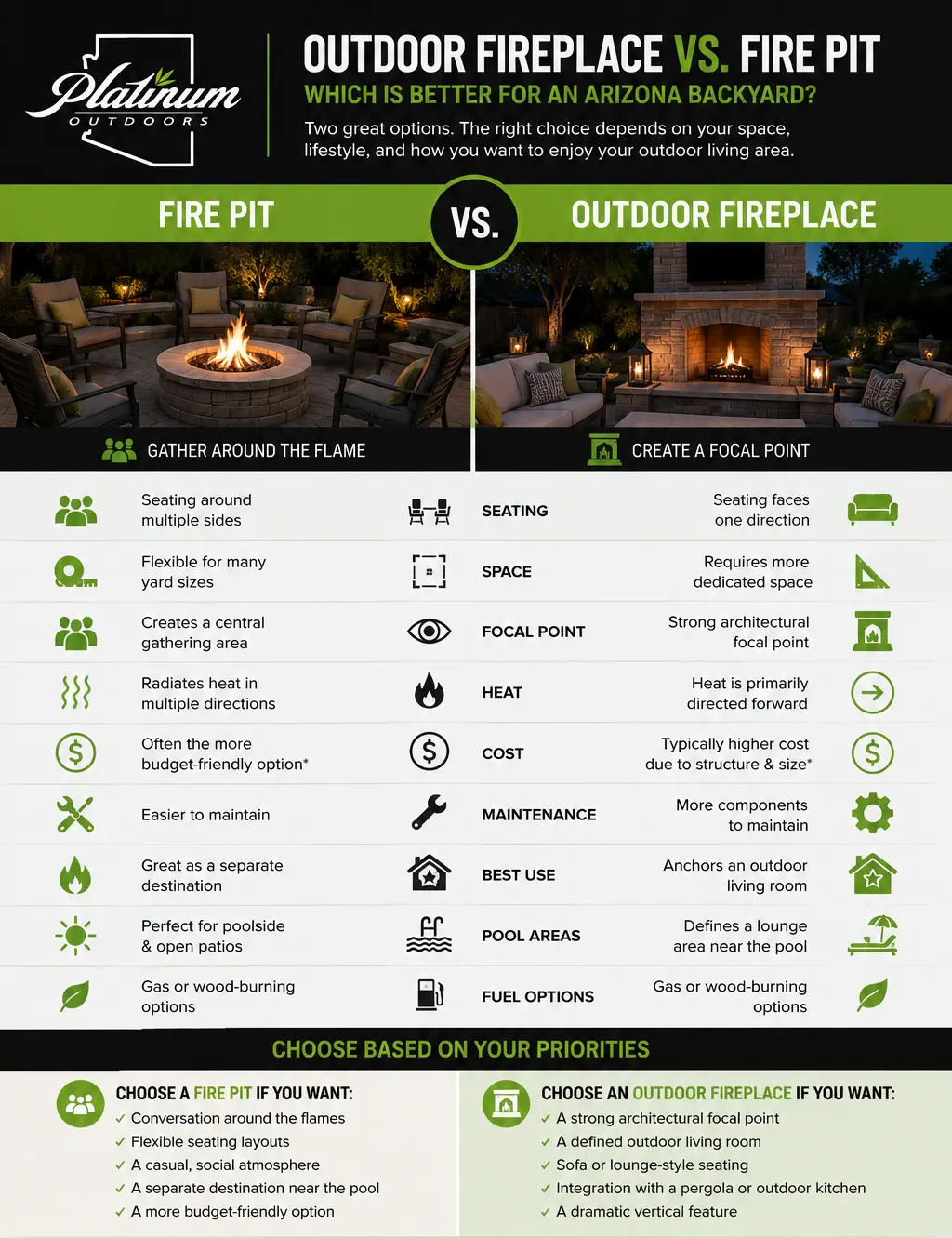
A fire pit is generally better for creating an open, social gathering area with seating around multiple sides. An outdoor fireplace is usually better for homeowners who want an architectural focal point and a more defined outdoor living room.
The right answer ultimately depends on how you want your backyard to function.
Outdoor Fireplace vs. Fire Pit: What’s the Difference?
The biggest difference between a fire pit and an outdoor fireplace is how each feature interacts with the surrounding space.
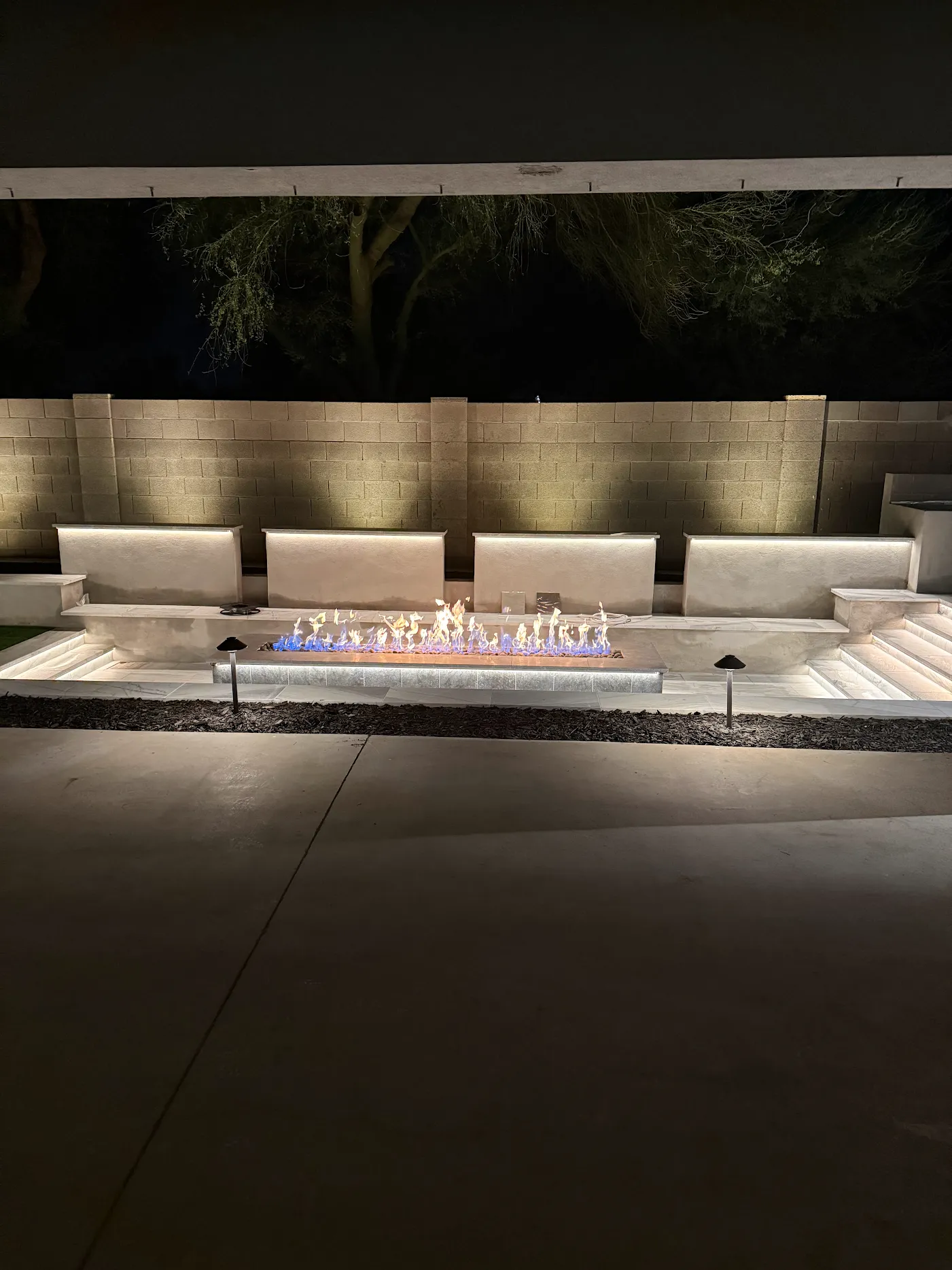
A fire pit typically sits near the center of a seating area. Depending on its shape and design, people can gather around multiple sides of the flames. Fire pits may be circular, square, rectangular, sunken, raised, or incorporated into a custom patio.
An outdoor fireplace is generally positioned along one side of an outdoor living area. Like an indoor fireplace, it creates a strong focal point with seating arranged primarily in front of it.
That distinction can have a major effect on backyard design.
A fire pit tends to create a social gathering zone.
An outdoor fireplace tends to create an outdoor room.
Homeowners interested in a permanent built-in feature can learn more about custom fire pit installation.
For a larger architectural fire feature, explore our outdoor fireplace installation services.
Quick Comparison: Fire Pit vs. Outdoor Fireplace
| Feature |
Fire Pit |
Outdoor Fireplace |
| Seating |
Can accommodate seating around multiple sides |
Primarily faces one direction |
| Space Required |
Flexible for many yard sizes |
Usually requires a more dedicated area |
| Visual Impact |
Creates a central gathering point |
Creates a strong architectural focal point |
| Heat Direction |
Radiates around the feature |
Primarily directed toward seating |
| Patio Integration |
Excellent |
Excellent |
| Outdoor Kitchen Integration |
Often creates a separate gathering zone |
Can anchor the main lounge |
| Design Style |
Casual to highly customized |
Typically more architectural |
| Fuel Options |
Gas or wood-burning |
Gas or wood-burning |
| Best For |
Conversation and group gathering |
Defined outdoor living rooms |
Neither option is inherently better. The best choice depends on what you want that portion of the backyard to become.
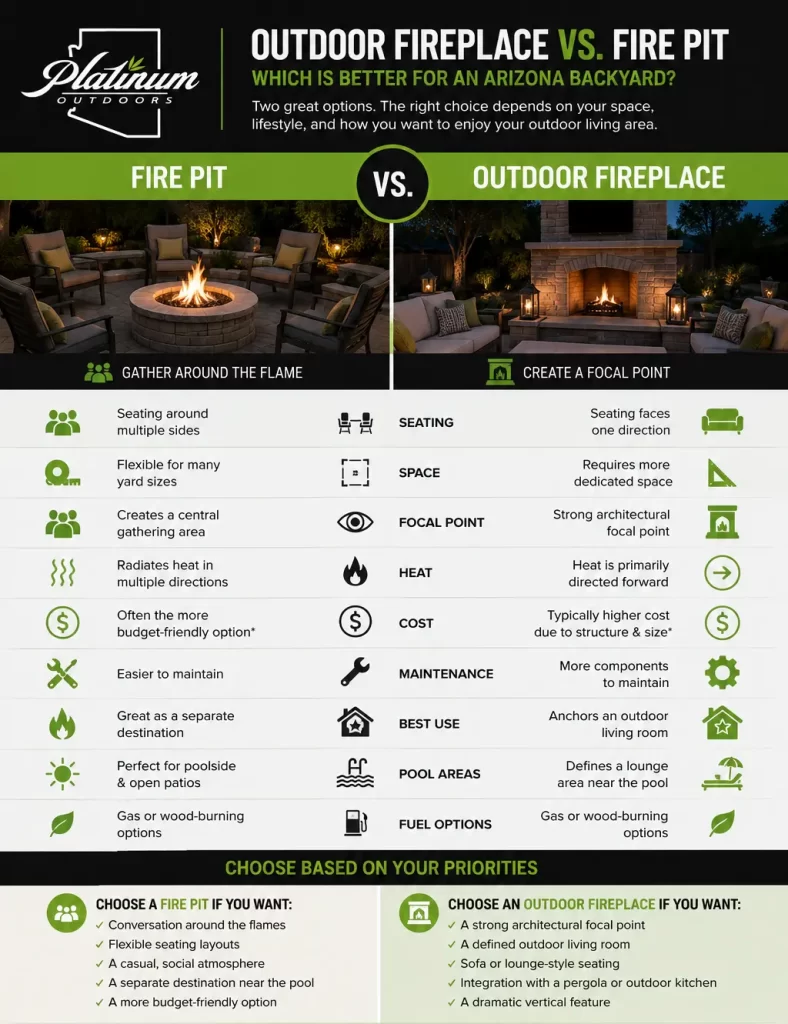
Which Is Better for Entertaining?
For homeowners who regularly host family and friends, a fire pit often has an advantage because of its seating configuration.
People can gather around the flames rather than facing a single direction. A circular or square fire pit surrounded by chairs or a built-in seating wall naturally creates a conversational arrangement.
That makes fire pits especially effective for:
- Casual gatherings
- Family evenings outside
- Larger groups
- Conversation areas
- Open patios
- Poolside entertainment spaces
An outdoor fireplace creates a different atmosphere.
Instead of sitting around the fire, guests generally gather in front of it. This can make the area feel more like an outdoor family room.
Outdoor fireplaces work particularly well with sofas, lounge chairs, outdoor dining areas, televisions, and adjacent outdoor kitchens.
Homeowners planning multiple backyard features should consider the fire feature within the broader outdoor living design rather than treating it as an isolated upgrade.
Fire Pit vs. Outdoor Fireplace: Which Gives Off More Heat?
A fire pit generally releases heat in multiple directions. People sitting around its perimeter can experience warmth from several sides of the feature.
An outdoor fireplace is more directional. The firebox and surrounding structure establish a clear front to the feature, with seating normally positioned accordingly.
That doesn’t necessarily mean one produces more heat than the other.
Actual performance depends on factors such as:
- Fire feature dimensions
- Burner size
- Fuel type
- Firebox design
- Distance between the fire and seating
- Wind conditions
- Surrounding walls and structures
In Arizona, outdoor fire features are especially appealing during cooler fall evenings, winter, and early spring.
During these months, both options can extend the usefulness of a patio or outdoor living area after sunset.
Fire Pit vs. Fireplace for a Small Arizona Backyard
A fire pit can often be easier to incorporate into a smaller yard because of the number of available shapes and configurations.
Compact rectangular or square fire pits can fit into smaller patio layouts, while built-in designs can sometimes be integrated directly into an existing hardscape.
That flexibility is valuable in Phoenix-area yards where a pool, turf, landscaping, or patio already consumes much of the available space.
An outdoor fireplace usually requires more dedicated room. The structure itself occupies vertical and horizontal space, while the seating needs to remain primarily in front of it.
That doesn’t mean a fireplace can’t work in a small yard.
In the right layout, a fireplace can define the edge of a patio and make a compact backyard feel more intentional.
For smaller properties, the better question isn’t simply:
Which fire feature takes up less space?
It is:
Which layout uses the available space more efficiently?
Our guide to small backyard design ideas for Phoenix homes explores additional ways to plan multifunctional outdoor spaces.
Outdoor Fireplace vs. Fire Pit Cost: Which Usually Costs More?
Cost is one of the most important considerations when comparing an outdoor fireplace vs. fire pit.
A fire pit is often the simpler structure, while a full outdoor fireplace can require substantially more masonry and structural work. However, highly customized fire pits can also become significant construction projects.
Rather than focusing only on the price of the fire feature itself, homeowners should consider the complete installation.
Factors that can influence fire pit or outdoor fireplace cost include:
- Size and dimensions
- Masonry construction
- Stone, stucco, brick, or veneer
- Foundation or footing requirements
- Gas-line installation
- Distance from an existing gas source
- Burner equipment
- Firebox construction
- Paver or concrete modifications
- Built-in seating
- Site access
- Demolition
- Electrical work
- Custom finishes
- Surrounding landscape improvements
For example, a custom gas fire pit installed as part of a new paver patio may involve excavation, gas-line planning, hardscape installation, and seating design.
An outdoor masonry fireplace incorporated into a pergola and outdoor kitchen project may involve an even larger scope.
This is why comparing only the cost of a standalone fire pit with the cost of a complete outdoor fireplace can be misleading.
The more useful comparison is the total cost of creating the finished outdoor space you want.
Custom Masonry Fire Pit vs. Outdoor Fireplace
Permanent fire features can also be customized to coordinate with the architecture and landscape surrounding them.
A custom masonry fire pit can be constructed using materials and finishes that complement nearby pavers, seating walls, columns, or outdoor kitchen features.
Depending on the design, a masonry fire pit may incorporate:
- Concrete block or other masonry construction
- Stone veneer
- Stucco
- Brick
- Paver accents
- Decorative caps
- Fire glass
- Built-in seating
An outdoor masonry fireplace is typically a larger architectural element.
Its design may incorporate a hearth, firebox, chimney or venting components where applicable, mantels, stonework, stucco, tile, or other finishes.
The added height makes the fireplace visible from much farther across the property.
That can make it especially effective when the goal is to create a visual centerpiece.
A custom fire pit is usually about creating a destination to gather around.
A custom outdoor fireplace is more often about creating a structure that defines the space.
Built-In Fire Pit vs. Portable Fire Pit
Not every backyard requires permanent construction.
Portable fire pits provide occasional use without becoming part of the landscape. They may make sense for homeowners who value flexibility or aren’t ready for a larger backyard project.
A built-in fire pit, however, becomes part of the property.
Custom fire pits can be integrated with:
- Paver patios
- Seating walls
- Outdoor kitchens
- Pool decks
- Landscape beds
- Pergolas
- Outdoor lighting
- Other masonry features
This gives homeowners much more control over how the fire pit fits the surrounding landscape.
A built-in fire pit surrounded by a custom paver patio can use complementary materials, patterns, and dimensions so the area feels like one cohesive space.
Gas vs. Wood-Burning Fire Pit or Fireplace in Arizona
Fuel type is especially important for Arizona homeowners.
Both fire pits and outdoor fireplaces can potentially use gas or wood depending on the design, property, jurisdiction, and applicable requirements.
Gas Fire Features
Gas fire pits and fireplaces provide convenient operation and consistent flames without requiring homeowners to store firewood.
Potential advantages include:
- Quick ignition
- Minimal ash cleanup
- No firewood storage
- Controlled flame
- Convenient frequent use
- Easy integration into many entertainment spaces
The project may require a gas line or other fuel setup, which needs to be incorporated into the design and installation scope.
Wood-Burning Fire Features
Wood provides the traditional crackling-fire experience many homeowners associate with an outdoor fireplace or fire pit.
Potential advantages include:
- Traditional flame appearance
- Natural wood-burning atmosphere
- Familiar campfire experience
- No permanent gas burner required for the flame itself
However, wood-burning fire features also create smoke, ash, embers, and additional cleanup.
And in the Phoenix area, there is another major consideration: burning restrictions.
Are Wood-Burning Fire Pits and Fireplaces Allowed in Arizona?
Homeowners should check local rules before assuming a wood-burning fire feature can be used whenever they want.
Maricopa County regulates residential wood burning, including certain outdoor fire pits and fireplaces that burn solid fuels.
The county can also declare No Burn Days because of air-quality conditions. During applicable restrictions, residents may be prohibited from burning wood outdoors.
Maricopa County also maintains seasonal rules for certain recreational burning activities within designated areas.
Because restrictions and requirements can change, homeowners considering a wood-burning fire pit or fireplace should review the current Maricopa County residential burning requirements before making a final fuel decision.
Rules may also vary depending on municipality, property, equipment, and project type.
That makes gas vs. wood more than an aesthetic choice in Arizona.
For homeowners who want convenient, frequent use, local wood-burning restrictions may be another factor that makes a gas fire feature worth considering.
Which Looks Better: An Outdoor Fireplace or Fire Pit?
Outdoor fireplaces generally have the advantage when the goal is a dramatic architectural focal point.
A fireplace is a vertical structure, so it remains visually prominent even when it isn’t being used.
Stone, stucco, brick, tile, and other finishes can turn the fireplace into a defining feature of the entire backyard.
It can also visually connect multiple elements, such as:
- Pergola columns
- Outdoor kitchen cabinetry
- Paver materials
- Seating walls
- Countertops
- Landscape lighting
- Architectural finishes on the home
Fire pits create focal points differently.
Instead of defining the area vertically, the fire pit typically becomes the center of the gathering space.
A custom paver layout, seating wall, or furniture arrangement can reinforce this effect.
If the goal is a dramatic architectural statement, the outdoor fireplace may win.
If the goal is making the gathering itself the center of the experience, a fire pit may be the better fit.
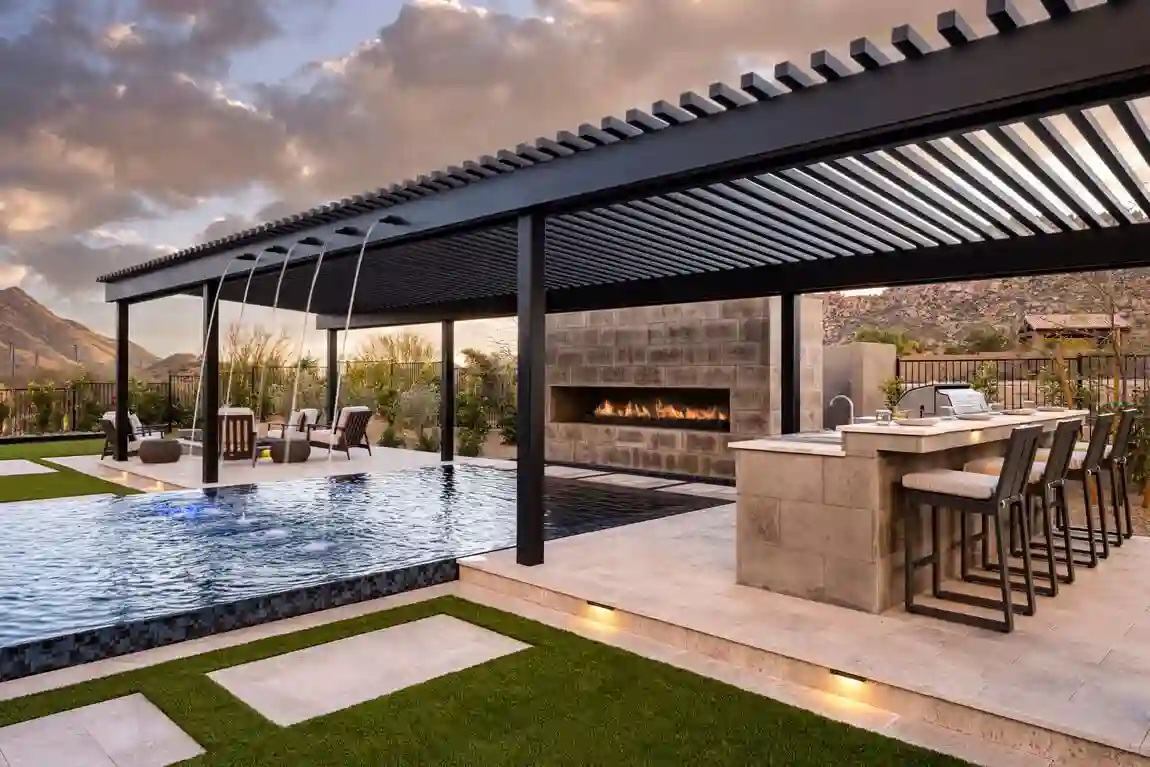
Outdoor Fireplace With a Pergola
Outdoor fireplaces and shade structures can work well together because they help establish the feeling of a true outdoor room.
A fireplace may be positioned near a pergola seating area, outdoor kitchen, dining area, or covered entertainment space.
This combination can visually define one part of the backyard while leaving the rest open for a pool, lawn, landscaping, or additional entertainment areas.
Platinum Outdoors has explored several ideas for combining a pergola with a fireplace in an Arizona backyard.
Placement around covered structures requires careful planning.
Clearances, construction materials, ventilation, heat exposure, and applicable requirements all need to be considered.
Homeowners considering both features can also explore our custom pergola installation options.
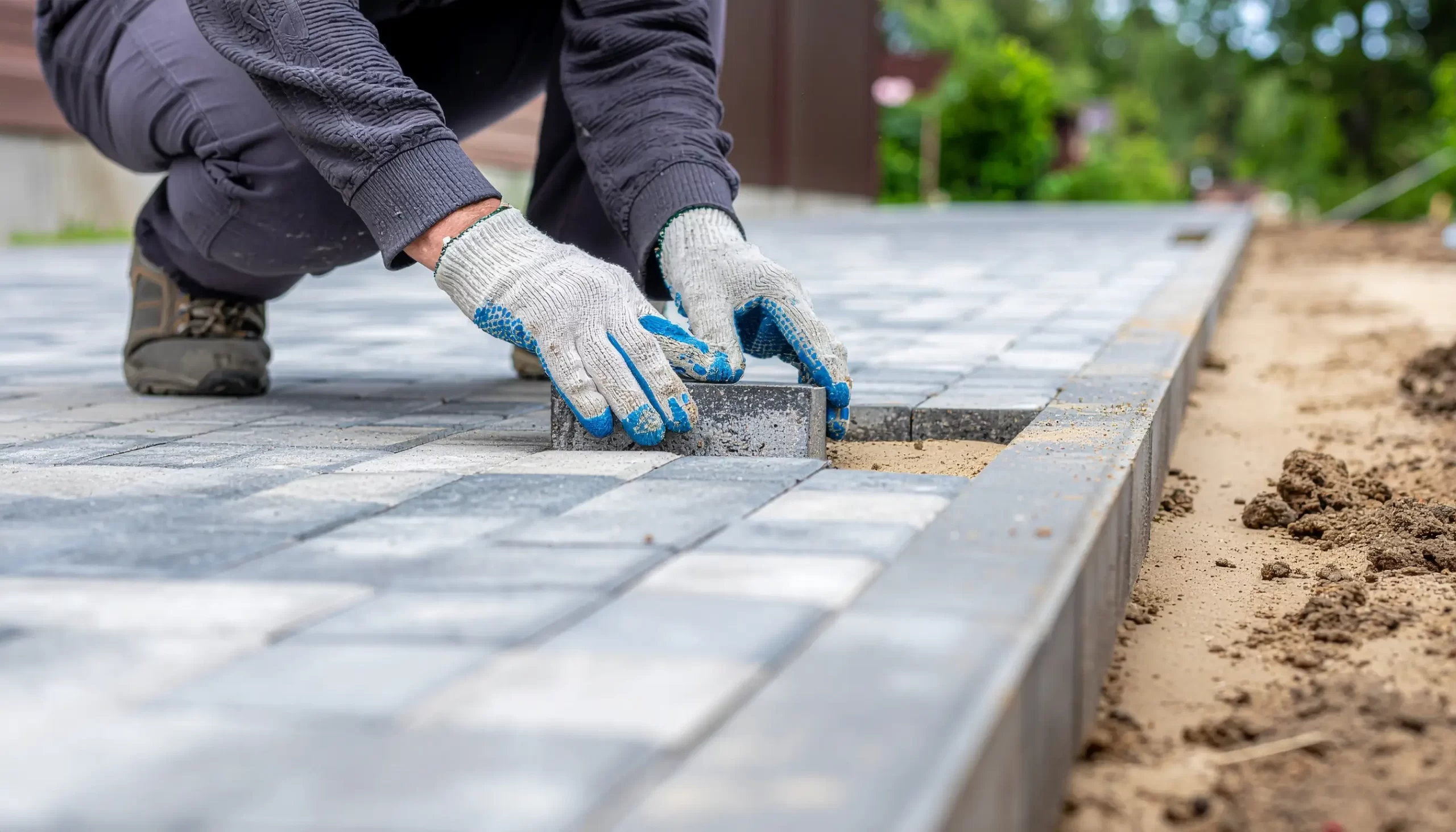
Fire Pit With a Paver Patio
Fire pits and pavers naturally complement one another because the patio creates a defined gathering surface around the fire.
The paver pattern can even be designed around the feature.
A circular fire pit might use a radial paver pattern, while a rectangular fire pit can complement a modern linear patio.
Built-in seating walls can further define the area.
Planning the fire feature and patio together also allows contractors to coordinate:
- Fire pit location
- Patio dimensions
- Seating distance
- Walkways
- Gas lines
- Drainage
- Landscape beds
- Lighting
Our guide to planning a custom paver patio installation covers additional hardscape design considerations.
Which Is Better Near an Outdoor Kitchen?
Both options can work well, but they create very different layouts.
An outdoor fireplace can complement a kitchen and dining area by anchoring a lounge at the opposite side of the space.
The layout might flow:
Cooking → Dining → Lounge → Fireplace
That makes the entire area feel like one large outdoor room.
A fire pit often works better as a separate destination.
The layout could instead become:
Outdoor Kitchen → Dining Patio → Fire Pit Conversation Area
This can be especially effective in larger yards where homeowners want multiple outdoor zones instead of placing every feature together.
Homeowners planning a cooking and entertainment area can explore our outdoor kitchen installation services and outdoor kitchen planning checklist.
Fire Pit vs. Outdoor Fireplace Near a Pool
A pool adds another dimension to the decision.
A fire pit can create a separate evening gathering destination near the pool deck. Chairs or built-in seating can surround the flames while keeping the main patio open.
An outdoor fireplace can instead define a lounge area at one edge of the pool.
This may work particularly well when the fireplace is incorporated into a larger patio, covered seating area, or outdoor kitchen.
Either way, circulation is important.
People moving between the house, pool, patio, and seating areas shouldn’t have to navigate awkwardly around the fire feature.
The size of the feature should also match the scale of the pool area.
A small fire pit may become visually lost beside a large pool deck, while an oversized fireplace can overwhelm a compact yard.
Homeowners already making significant changes around the pool can incorporate the fire feature into a broader pool remodeling and landscape plan.
Outdoor Fireplace vs. Fire Pit Maintenance
Both types of fire features require maintenance, but the amount and type largely depend on fuel and materials.
Fire Pit Maintenance
Typical upkeep may involve:
- Removing ash from wood-burning designs
- Cleaning burner components
- Removing debris
- Inspecting masonry
- Cleaning fire glass
- Checking gas components
- Maintaining surrounding pavers
Outdoor Fireplace Maintenance
Outdoor fireplaces may require similar maintenance along with attention to:
- Firebox condition
- Chimney or venting components where applicable
- Exterior masonry
- Stone or stucco finishes
- Hearth surfaces
Arizona conditions create additional considerations.
Dust, UV exposure, seasonal winds, and monsoon debris can affect outdoor surfaces even when the fire feature isn’t being used.
Selecting materials designed for long-term exterior exposure can simplify maintenance and help the feature coordinate with the rest of the landscape over time.
Arizona Climate Considerations for Outdoor Fire Features
An Arizona fire feature serves a somewhat different purpose than one installed in a colder climate.
Homeowners generally aren’t trying to heat their backyard through a long freezing winter.
Instead, fire features help make patios more inviting during cooler evenings while providing ambiance throughout much of Arizona’s outdoor-entertaining season.
Intense Sun Exposure
Exterior finishes receive significant UV exposure.
Materials should be selected for Arizona conditions rather than simply copying a design created for a different climate.
Wind
Wind can influence flame behavior and seating comfort.
Walls, structures, neighboring properties, and open areas all affect how air moves through a yard.
Monsoon Weather
Drainage should be considered around hardscape and permanent fire features.
Water should be directed appropriately rather than creating unnecessary problems around masonry, burners, patios, or seating areas.
Surrounding Materials
Artificial turf, landscaping, patio furniture, shade structures, and other nearby materials all need to be considered during placement.
A fire feature should be treated as one part of the overall landscape rather than a standalone object.
Does an Outdoor Fireplace or Fire Pit Add More Value?
There isn’t a universal ROI that applies to every fire pit or outdoor fireplace.
The effect on a home’s appeal depends on factors such as:
- Construction quality
- Design
- Available yard space
- Condition
- Ease of use
- Integration with the surrounding landscape
- Local buyer preferences
A well-designed fire feature that feels intentional can make an outdoor living space more attractive and functional.
However, a fire pit or fireplace that consumes too much space or looks disconnected from the rest of the yard may not have the same effect.
This is another reason overall landscape design matters.
The goal isn’t simply to add another feature.
The goal is to make the backyard work better as a complete outdoor environment.
What Should a Contractor Consider Before Building a Fire Feature?
Professional fire feature installation involves more than selecting a design.
Before construction, a fire pit or outdoor fireplace contractor may need to evaluate factors such as:
- Available space
- Fire feature dimensions
- Existing hardscape
- Gas access
- Utility locations
- Drainage
- Nearby structures
- Seating distance
- Walkways
- Artificial turf
- Landscape materials
- Pool location
- Future outdoor kitchen plans
- Future shade structures
- Masonry finishes
- Local requirements
Thinking through these factors before installation can prevent a feature from interfering with future backyard improvements.
It also makes it easier to coordinate the fire pit or fireplace with pavers, walls, landscaping, lighting, and other outdoor features.
Do You Need a Permit for an Outdoor Fireplace or Fire Pit in Arizona?
Permit and inspection requirements can depend on the location and scope of the project.
Factors may include:
- Municipality
- Fuel source
- Gas-line work
- Electrical work
- Structural construction
- Size
- Placement
- Proximity to other structures
Requirements can vary between Phoenix, Scottsdale, Mesa, Gilbert, Chandler, Queen Creek, and other Arizona communities.
Homeowners should verify current requirements with the appropriate local building department before construction begins.
A professional installer should also account for applicable requirements while planning the project.
Fire Pit or Outdoor Fireplace? Choose Based on Your Backyard
Still having trouble deciding? This simplified comparison can help.
| Your Priority |
Better Fit |
| Conversation around the flames |
Fire Pit |
| Architectural focal point |
Outdoor Fireplace |
| Seating around multiple sides |
Fire Pit |
| Defined outdoor room |
Outdoor Fireplace |
| Flexible furniture layout |
Fire Pit |
| Sofa or lounge configuration |
Outdoor Fireplace |
| Separate destination near a pool |
Fire Pit |
| Integration into a larger lounge |
Outdoor Fireplace |
| Strong vertical design element |
Outdoor Fireplace |
| Casual gathering atmosphere |
Fire Pit |
| Integration with an open paver area |
Fire Pit |
| Architectural integration with a pergola |
Outdoor Fireplace |
These aren’t absolute rules.
A good landscape design can adapt either feature to many different situations.
The table simply illustrates the experience each option naturally creates.
Should You Build the Fire Feature First or Design the Backyard First?
Whenever possible, design the overall backyard first.
Installing a fire feature without considering future improvements can result in awkward spacing or make later projects more difficult.
Homeowners may eventually want to add:
- Outdoor kitchen
- Pergola
- Ramada
- Paver patio
- Artificial turf
- Pool upgrades
- Outdoor lighting
- Seating walls
- Landscape beds
A fire pit installed in the wrong location can interfere with those plans.
A coordinated backyard renovation allows the fire feature to become part of a larger layout.
This is particularly important for new or unfinished yards where utilities, irrigation, drainage, hardscape, lighting, and planting areas can potentially be planned together.
Outdoor Fireplace Pros and Cons
An outdoor fireplace may be the better choice for homeowners who want a permanent architectural focal point.
Advantages
- Creates a defined outdoor living room
- Provides a strong architectural feature
- Works well with lounge furniture
- Can complement outdoor kitchens and pergolas
- Directs attention toward one side of the space
- Offers extensive opportunities for custom masonry finishes
Potential Drawbacks
- Requires more dedicated space
- Usually creates less flexible seating
- Can involve more structural construction
- May visually dominate very small yards
- Placement requires careful coordination with surrounding features
Fire Pit Pros and Cons
A fire pit often works best for homeowners who prioritize gathering and conversation.
Advantages
- Encourages group seating
- Works with many patio layouts
- Can accommodate different yard sizes
- Available in numerous shapes
- Integrates naturally with seating walls and pavers
- Can create a separate entertainment destination
Potential Drawbacks
- Requires circulation space around the feature
- Can occupy valuable central patio space
- Open layouts may provide less wind protection
- Seating needs careful planning
- Poor placement can interfere with future backyard improvements
Our guide on how to choose the best fire pit for your Arizona backyard explores fire pit selection in greater detail.
Can You Have Both a Fire Pit and an Outdoor Fireplace?
In a large enough backyard, absolutely.
The two features don’t necessarily serve the same purpose.
An outdoor fireplace might anchor the primary covered patio while a separate fire pit creates a casual gathering area elsewhere in the yard.
For example:
Covered Patio + Outdoor Kitchen + Fireplace
could form the primary outdoor living room.
Meanwhile:
Pool + Open Patio + Fire Pit
could create a second evening gathering destination.
Larger landscape projects often benefit from creating distinct outdoor “rooms” rather than forcing every amenity into one area.
The key is giving each space a purpose and connecting them with natural pathways.
Frequently Asked Questions
Is an outdoor fireplace better than a fire pit?
Neither is automatically better. Fire pits generally work well for conversational seating and open gathering areas, while outdoor fireplaces are better suited to creating a defined architectural focal point and outdoor living room.
Does a fire pit provide more heat than an outdoor fireplace?
A fire pit often distributes heat in more directions because seating can surround it. An outdoor fireplace primarily directs heat toward the area in front. Actual performance depends on design, fuel source, dimensions, and surrounding conditions.
Is a fire pit cheaper than an outdoor fireplace?
Fire pits are often simpler structures, but project costs vary considerably. Custom masonry, gas lines, pavers, seating walls, site preparation, foundations, and other construction requirements can influence the cost of either option.
Can you put a fire pit on a paver patio?
Fire pits are commonly incorporated into paver patio designs. Materials, clearances, construction details, fuel type, placement, and applicable local requirements should all be considered during planning.
Can you put an outdoor fireplace under a pergola?
Fire features near or beneath structures require careful planning. Clearances, ventilation, construction materials, heat exposure, manufacturer specifications, and applicable requirements should be reviewed before construction.
Is gas or wood better for an Arizona fire pit?
Gas provides convenient ignition and minimal cleanup, while wood creates a traditional fire experience. Arizona homeowners should also consider local wood-burning restrictions, property conditions, maintenance expectations, and how frequently they expect to use the feature.
Are wood-burning fire pits allowed in Phoenix?
Residential wood burning in Maricopa County is subject to air-quality and burning restrictions, including No Burn Days. Requirements can change, so homeowners should check current county and local rules before using a wood-burning fire feature.
Do I need a permit for a fire pit or outdoor fireplace?
Requirements depend on the municipality and project. Gas-line work, electrical work, structural construction, placement, and other factors may affect whether permits or inspections are necessary. Check with the appropriate local building department before construction.
What is the best place to put a fire pit in a backyard?
The best location depends on yard size, circulation paths, surrounding structures, landscaping, fuel type, seating arrangement, utilities, and applicable safety requirements. Placement is best determined as part of the overall backyard design.
Designing the Right Fire Feature for Your Arizona Backyard
The best fire feature isn’t necessarily the largest, most expensive, or most elaborate option.
It’s the one that fits naturally into the backyard.
A custom fire pit can transform an unused portion of a patio into a gathering place. An outdoor fireplace can turn a seating area into a defined outdoor room. Either becomes more effective when planned alongside pavers, shade structures, landscaping, lighting, pools, outdoor kitchens, and other features.
For homeowners planning more than one backyard improvement, approaching the project as a complete landscape design helps ensure the different elements work together.
The choice between an outdoor fireplace and fire pit ultimately comes down to the experience you want to create.
A fire pit puts the gathering around the flames.
An outdoor fireplace puts the fire at the center of the view.
For an Arizona backyard designed around outdoor living, either can be the right choice when the layout, materials, fuel source, and surrounding features are planned as one cohesive space.