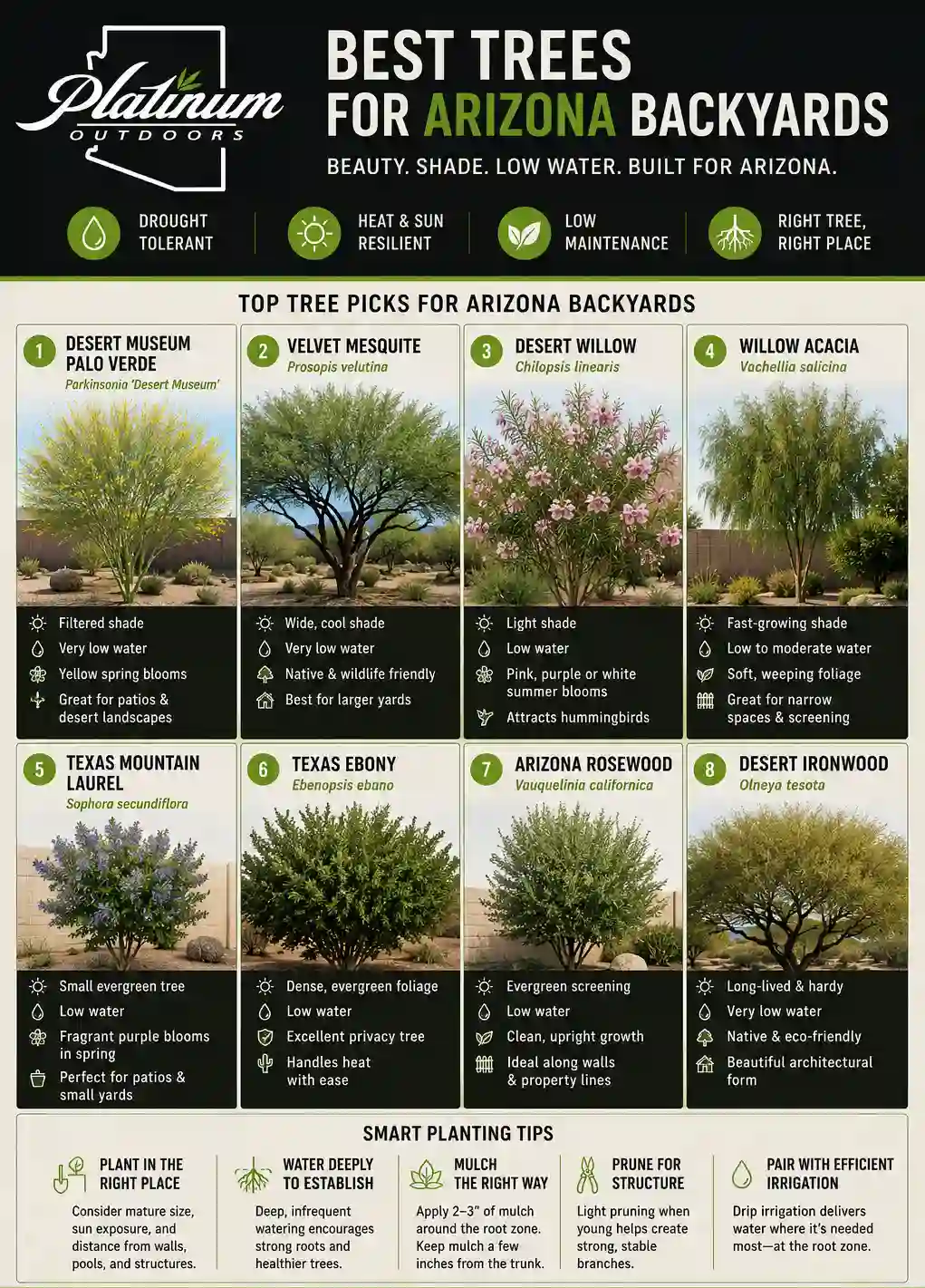
Choosing the best trees for Arizona backyards is not just about picking something pretty at the nursery. In Phoenix, Chandler, Gilbert, Queen Creek, Mesa, Scottsdale, and the surrounding East Valley, a backyard tree has to handle intense sun, reflected heat, alkaline soil, seasonal drought, monsoon winds, and limited irrigation. The right tree can add shade, soften hardscape, improve comfort around patios, create privacy, frame outdoor living spaces, and make a yard feel more complete. The wrong tree can outgrow the space, drop too much debris near a pool, demand more water than expected, or sit in the wrong exposure and struggle through summer.
For most Arizona homeowners, the best backyard trees are drought tolerant, heat adapted, thoughtfully placed, and matched to the way the yard will actually be used. A tree for a west-facing patio has different requirements than a tree near a pool, a narrow side yard, a new construction backyard, or a small courtyard. This guide breaks down the best shade trees, flowering trees, low-water trees, privacy trees, and small-yard trees for Arizona backyards so you can make a smarter landscape decision before planting.
Why Tree Selection Matters in Arizona Backyards
Arizona backyards are shaped by heat first. During the warmest months, patios, pavers, turf, block walls, stucco, gravel, and pool decks absorb and reflect sunlight. A well-placed tree can make an outdoor area feel more comfortable by providing filtered shade and visual softness. It can also help define outdoor rooms, frame a seating area, and make a backyard feel less exposed.
Tree selection also matters because many Phoenix-area homes are in HOA communities, master-planned neighborhoods, and new construction developments where yard sizes, drainage patterns, and approved plant lists may be limited. A large canopy tree may be beautiful, but it may not be the right choice for a narrow backyard with a pool, turf strip, paver patio, outdoor kitchen, and shared block walls. In those cases, smaller desert-adapted trees or multi-trunk accent trees often work better.
Before choosing a tree, think through the whole backyard plan. Is the tree meant to shade a patio? Screen a neighbor’s second-story window? Add seasonal flowers? Reduce heat near artificial turf? Create structure in a xeriscape design? Support a poolside landscape? The answer should guide the tree type, size, placement, and irrigation approach.
If your yard is still in the planning stage, tree placement should be considered alongside patios, turf, pavers, ramadas, pergolas, irrigation, lighting, and planting beds. For more whole-yard inspiration, Platinum Outdoors’ guide to Arizona backyard ideas pairs well with this tree selection guide.
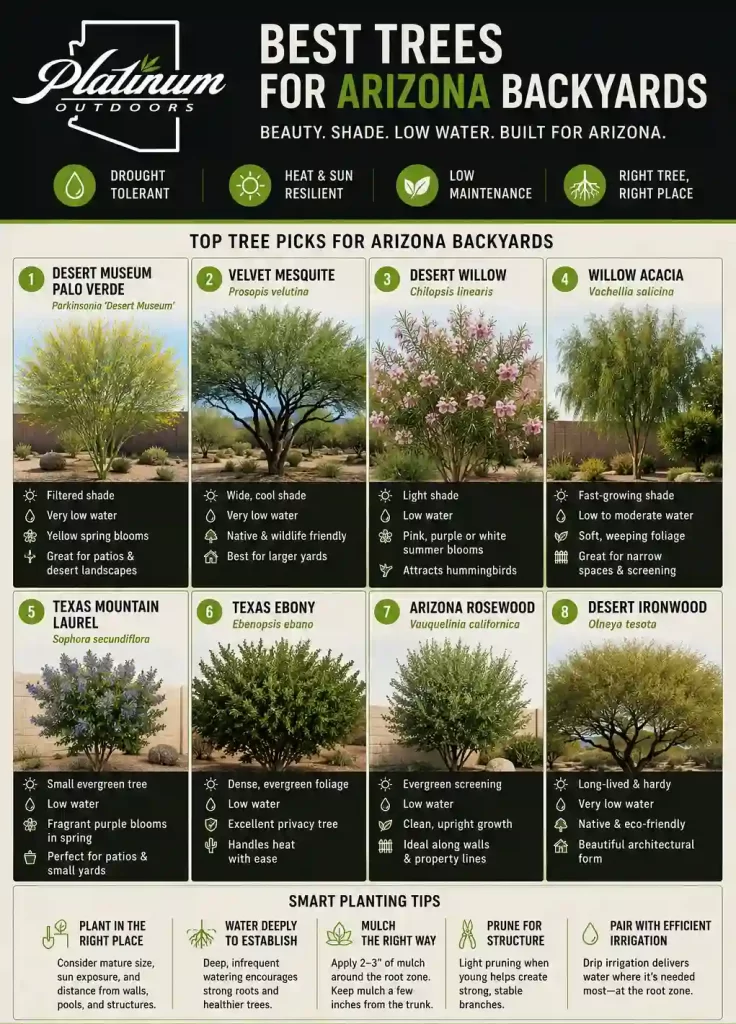
What to Look for in a Backyard Tree in Arizona
Drought Tolerance and Low Water Use
Most Arizona homeowners want trees that can thrive with responsible irrigation rather than constant watering. “Drought tolerant” does not mean a new tree can be planted and ignored. Young trees need regular, deep watering while they establish. Once established, many desert-adapted trees can transition to deeper, less frequent watering. That is why pairing the right tree with the right irrigation layout is important.
Low-water trees tend to perform best when their watering is matched to root growth rather than shallow surface wetting. Drip irrigation is commonly used in Arizona landscapes because it can direct water to the root zone more efficiently than broad spray irrigation. If a backyard is being remodeled, it is worth planning tree irrigation before finalizing turf, pavers, gravel, and planting areas. Platinum Outdoors’ irrigation installation page is a helpful internal resource for understanding how irrigation fits into a complete landscape plan.
Heat and Reflected Sun Tolerance
Not every tree that grows in Arizona should be planted in every backyard location. A tree near a west-facing wall, driveway, or large paver patio may face reflected heat for hours. South and west exposures are usually more demanding than east-facing or partially shaded areas. Trees that tolerate full sun and reflected heat are better choices for exposed areas.
Mature Size
One of the most common backyard tree mistakes is choosing a tree based on how it looks in a nursery container rather than how large it will become. A small tree today may eventually interfere with rooflines, walls, pool equipment, outdoor kitchens, pergolas, pathways, or neighboring properties. In compact yards, smaller trees with moderate canopies are often more practical than large shade trees.
Root Behavior
Root systems matter near pools, patios, walls, foundations, and utility lines. No tree should be treated as completely “root-proof,” but some trees are better suited to constrained spaces than others. The University of Arizona Cooperative Extension emphasizes evaluating both above-ground and below-ground space before choosing plants, including mature plant size and available root area. You can review their plant selection guidance here: Choosing the Right Plants.
Debris and Maintenance
All trees drop something. Some drop leaves, flowers, seed pods, bark, fruit, or pollen. This is especially important near pools, putting greens, outdoor kitchens, fire pits, and paver patios. If the tree is close to a pool, choose a species with lower litter potential and avoid heavy pod or flower drop near the waterline.
Best Shade Trees for Arizona Backyards
Desert Museum Palo Verde
The Desert Museum Palo Verde is one of the most popular choices for Arizona backyard shade. It is known for its bright green trunk, filtered shade, yellow spring flowers, and desert-adapted performance. Compared with some traditional palo verde species, Desert Museum Palo Verde is often favored in residential landscapes because it is thornless and has an attractive multi-trunk form.
This tree works well as a focal point in a xeriscape yard, a shade tree near a patio, or a visual anchor in a low-water planting bed. It provides dappled shade rather than a dense, dark canopy, which is useful in Arizona because many desert plants still need sunlight. It is also a strong fit for homeowners who want an unmistakably Arizona look without choosing a high-water tree.
Best use: Shade for patios, open gravel areas, xeriscape designs, and front or backyard focal points.
Watch-outs: Palo verdes can drop flowers and seed pods, so placement near pools should be considered carefully. They also need enough room to develop their natural branching structure.
Velvet Mesquite
Velvet mesquite is a classic Sonoran Desert tree and one of the strongest options for homeowners who want a native, drought-tolerant shade tree. It has a broad canopy, fine-textured foliage, and a natural desert character that works beautifully in Arizona landscapes. Mesquite trees can create generous shade once mature, making them useful for larger backyards and outdoor living areas.
The University of Arizona Cooperative Extension notes that mesquite and palo verde trees are important urban landscape trees in Arizona, with mesquites valued for drought tolerance and adaptability. Their detailed publication on Mesquite and Palo Verde Trees for the Urban Landscape is a useful resource for deeper species research.
Best use: Larger backyard shade areas, desert landscapes, wildlife-friendly yards, and naturalistic designs.
Watch-outs: Mesquites need room. Avoid placing them too close to pools, foundations, small patios, or narrow beds. Some varieties have thorns, so confirm the specific selection before planting near walkways or play areas.
Ironwood
Desert ironwood is a slow-growing native tree with dense wood, small leaves, and a refined desert look. It can provide excellent shade over time, but it is not the fastest choice if immediate canopy is the top priority. Ironwood is especially valuable in naturalistic and xeriscape designs where long-term structure, native character, and low water use matter.
Because ironwood grows slowly, it is often best for homeowners who are thinking long term. It can become a beautiful architectural element in the yard, especially when paired with boulders, gravel, native shrubs, and low-water accents.
Best use: Native desert landscapes, larger xeriscape beds, long-term shade, and low-maintenance designs.
Watch-outs: Ironwood has thorns and should not be crowded into high-traffic areas. It is better placed where it can mature naturally without constant pruning.
Willow Acacia
Willow acacia is often used when homeowners want a faster-growing shade tree with a more upright, narrow form. Its weeping foliage creates a softer look than many desert trees, and its shape can work well in side yards, along walls, or in spaces that need height without an extremely broad canopy.
This tree is not native to Arizona, but it is commonly used in desert landscapes because it adapts well to heat and low-water conditions once established. It can be a useful option where a mesquite or large palo verde would be too wide.
Best use: Narrow spaces, side yards, privacy edges, and areas needing vertical softness.
Watch-outs: Willow acacia can grow quickly, so structural pruning may be needed early to encourage a balanced form.
Best Drought-Tolerant Trees for Arizona Yards
Desert Willow
Desert willow is one of the best flowering trees for Arizona backyards. Despite its name, it is not a true willow. It is a desert-adapted tree with narrow leaves and trumpet-shaped flowers that can appear in shades of pink, lavender, purple, or white depending on the variety. It brings color and movement to the landscape without requiring the same water needs as many lush, non-desert ornamentals.
Desert willow is especially useful for smaller yards, patios, and low-water planting designs. It can provide light shade, attract hummingbirds, and soften hardscape without becoming as massive as some larger shade trees. Because it drops flowers and seed pods, it should be placed thoughtfully around pools and high-use patios.
Best use: Flowering accent tree, small shade tree, patio tree, and desert garden focal point.
Watch-outs: It is deciduous, so it may look bare in cooler months. It also drops blooms and pods during the growing season.
Texas Mountain Laurel
Texas mountain laurel is a slow-growing evergreen that can be trained as a small tree or large shrub. It is valued for glossy green foliage and fragrant purple spring flowers. In Arizona backyards, it works well near patios, entry courtyards, and smaller planting areas where a compact evergreen tree is desired.
This is a good choice for homeowners who want year-round structure without a large canopy. It does not provide the same amount of shade as a mesquite or palo verde, but it adds form, fragrance, and color in a low-water design.
Best use: Courtyards, patios, accent planting, small yards, and evergreen structure.
Watch-outs: It grows slowly, so it is not the right choice when fast shade is the goal. The seeds are toxic, so placement should be considered carefully in yards with pets or young children.
Texas Ebony
Texas ebony is a dense, evergreen to semi-evergreen desert tree that can work well for privacy, screening, and shade in warmer parts of the Phoenix metro. It has small leaves, dark branching, fragrant flowers, and a strong architectural presence. Because it has a dense canopy, it can be useful where homeowners want more privacy than a light-filtering palo verde provides.
Best use: Privacy screening, evergreen structure, wildlife-friendly landscapes, and warm microclimates.
Watch-outs: It has thorns and should be kept away from narrow walkways or areas where people brush against branches.
Arizona Rosewood
Arizona rosewood is a strong option for homeowners who want an evergreen, upright tree or tall screening shrub. It has dark green foliage, a clean structure, and a more formal look than many desert trees. It can work along property lines, in privacy plantings, or as a background tree in layered landscapes.
Best use: Screening, privacy, evergreen structure, and side yard planting.
Watch-outs: It is not a broad shade tree. Use it more for vertical structure and privacy than for large canopy coverage.
For additional water-wise plant ideas, AMWUA’s Landscape Plants for the Arizona Desert database is a helpful resource for researching low-water plants suited to Central Arizona.
Best Trees for Phoenix Backyards with Pools
Pool landscaping in Arizona requires extra planning. The best poolside trees should provide shade or beauty without excessive litter, invasive root concerns, or sharp thorns near walking areas. No tree is completely mess-free, but some are better suited than others.
Best Pool-Friendly Tree Options
Desert Museum Palo Verde can work near pools if it is not planted too close to the water and if seasonal flower and pod drop are acceptable. Its filtered shade is useful around pool decks and nearby seating areas.
Texas mountain laurel can work as a small evergreen accent away from the immediate pool edge. It adds spring flowers and year-round structure without becoming a large canopy tree.
Arizona rosewood can be useful as a vertical privacy screen near pool areas, especially along block walls where homeowners want greenery without a wide-spreading tree.
Desert willow can be beautiful near a pool area, but it should be placed with care because flower and pod drop can be noticeable. It is often better near a patio or planting bed than directly over water.
Trees to Be Careful With Near Pools
Large mesquites, heavily littering trees, fruiting trees, and thorny trees should be placed carefully. This does not mean they cannot be used in a backyard with a pool. It means they should usually be placed farther from the waterline, pool equipment, and high-traffic walkways.
If the backyard includes a pool remodel, paver patio, turf area, and planting bed improvements, tree placement should be part of the larger layout. Platinum Outdoors’ pool remodeling page can help homeowners think through how planting, hardscape, and pool areas work together.
Best Trees for Small Backyards in Arizona
Small Arizona backyards need trees that provide impact without overwhelming the space. The goal is usually shade, privacy, color, or vertical structure, not a massive canopy that dominates the entire yard.
Desert Willow
Desert willow is one of the best small shade trees for Arizona patios. It has seasonal flowers, a light canopy, and a manageable size. It is especially helpful when you want a tree that feels soft and colorful without creating heavy shade.
Texas Mountain Laurel
Texas mountain laurel is excellent for compact spaces because it grows slowly and can be maintained as a small tree or large shrub. It brings evergreen foliage and spring fragrance, which makes it useful near entries, courtyards, or seating areas.
Arizona Rosewood
Arizona rosewood is useful for small yards where privacy matters. It grows upright, stays green, and can help screen walls or neighboring views without requiring a broad canopy.
Foothill Palo Verde
Foothill palo verde is generally smaller and slower-growing than some other palo verde options. It can fit in desert-style yards where homeowners want a native look and filtered shade, but it still needs enough space to develop naturally.
Small yards often benefit from combining one tree with layered shrubs, boulders, gravel, lighting, and compact hardscape areas. Platinum Outdoors’ blog on small backyard design ideas for Phoenix homes is a good companion piece for planning these spaces.
Best Trees for Privacy in Arizona Backyards
Privacy is a major reason homeowners add trees, especially in newer communities with two-story homes, shared walls, and compact lots. However, not every shade tree is a good privacy tree. Some trees have open canopies that provide filtered shade but limited screening. Others grow upright and dense, which makes them better for visual separation.
Arizona Rosewood
Arizona rosewood is one of the better choices for evergreen screening in Arizona backyards. It has a vertical habit and can be used along walls or property edges. It works especially well when combined with other shrubs and accents to create layered privacy.
Texas Ebony
Texas ebony can create a dense, attractive screen in suitable warm locations. Its dark foliage and branching structure make it useful where homeowners want a stronger visual barrier.
Willow Acacia
Willow acacia can provide height and softness along a property line. Because of its upright form, it may work in spaces where a broader tree would crowd the yard.
Texas Mountain Laurel
Texas mountain laurel is slower-growing, but it can become a beautiful privacy accent in smaller areas. It is better for selective screening than for quickly blocking a large view.
Privacy trees are often most effective when paired with design features like pergolas, ramadas, privacy walls, raised planters, or outdoor living zones. For shade planning beyond trees, see Platinum Outdoors’ guide to best shade structures for Arizona backyards.
Best Flowering Trees for Arizona Backyards
Flowering trees add seasonal interest and make a desert yard feel more vibrant. In Arizona, the key is choosing flowering trees that can handle heat without becoming high-water plants.
Desert Willow
Desert willow is one of the strongest flowering tree choices for Arizona. Its blooms can appear over a long warm-season window, and the flowers attract hummingbirds. It is a good fit for homeowners who want a soft, colorful, low-water accent.
Palo Verde
Palo verde trees provide one of the most recognizable spring flower displays in Arizona. Their yellow blooms bring bright color to desert landscapes and pair well with gravel, boulders, agave, cactus, and low-water shrubs.
Texas Mountain Laurel
Texas mountain laurel produces fragrant purple flower clusters in spring. It is slower-growing, but its evergreen foliage and dramatic bloom make it a strong choice for patios and courtyards.
Chaste Tree
Chaste tree, also called vitex, is a popular flowering option with purple bloom spikes and a summer color presence. It is not as desert-native in character as palo verde or mesquite, but it can work well in many Phoenix-area landscapes with proper irrigation and placement.
Flowering trees are especially effective when the rest of the yard uses simple desert textures. A single flowering tree can become the seasonal focal point in a yard with pavers, turf, gravel, lighting, and low-water plants.
Best Fast-Growing Trees for Arizona Backyards
Many homeowners want shade quickly, especially in a new construction backyard with no mature landscape. Fast-growing trees can help, but growth speed should not be the only deciding factor. Some fast-growing trees may need more structural pruning, more water while establishing, or more space than a small yard can provide.
Willow Acacia
Willow acacia is one of the better fast-growing options for Arizona yards because it handles heat and has a more upright form than many broad canopy trees. It can be useful when quick vertical softness and shade are important.
Desert Museum Palo Verde
Desert Museum Palo Verde is often chosen because it establishes relatively quickly compared with slower native trees. It provides filtered shade and an attractive desert look while staying lower-water once established.
Mesquite
Mesquite can grow quickly when given adequate water, especially during establishment. It is a strong shade tree for larger yards, but it should not be forced into tight spaces.
Desert Willow
Desert willow can establish well in the right location and provides seasonal flowers relatively quickly compared with very slow-growing trees. It is not a dense shade tree, but it is a good fast-impact ornamental option.
For new build backyards, speed should be balanced with long-term layout. A tree that grows fast but lands in the wrong place can create future design problems. Platinum Outdoors’ landscaping for new homes in Phoenix page is useful for homeowners planning a yard from scratch.
Where to Plant Trees in an Arizona Backyard
West-Facing Backyards
West-facing backyards often need shade the most because they receive strong afternoon sun. Trees that tolerate reflected heat are best here. Consider Desert Museum Palo Verde, mesquite, willow acacia, or desert willow depending on available space. Planting too close to a wall can create reflected heat stress and limit root development, so allow room for the canopy and root zone.
Near Patios
Patio trees should provide shade without creating excessive debris. Desert willow, Texas mountain laurel, and Desert Museum Palo Verde can all work depending on the patio size and how much litter is acceptable. If the patio has pavers, outdoor furniture, or a kitchen nearby, avoid heavy seed pod or fruit drop directly over the hardscape.
Near Pools
Poolside trees should be placed farther from the waterline when possible. Focus on lower-litter, manageable, well-spaced trees. Avoid trees with aggressive growth habits, heavy fruit drop, or thorns near traffic areas.
Along Walls and Property Lines
Privacy trees should be placed with mature canopy width in mind. Arizona rosewood, Texas ebony, and willow acacia can work well along walls, but avoid crowding them against block walls or utility lines.
Near Artificial Turf
Trees can help reduce heat around artificial turf by casting partial shade. However, dropping leaves, pods, or flowers can create cleanup needs. Choose placement carefully so the tree improves comfort without creating unnecessary maintenance. For related turf planning, see Platinum Outdoors’ guide to artificial turf vs. natural grass in Arizona.
Tree Care Tips for Arizona Backyards
Water Deeply During Establishment
Newly planted trees need consistent water as they establish. The goal is to encourage roots to grow outward and downward, not to keep the surface constantly wet. Deep watering is generally better than frequent shallow watering because shallow watering can encourage weak surface roots.
Use Mulch Correctly
Mulch can help reduce soil temperature and slow moisture loss around the root zone. Keep mulch away from the trunk itself and spread it outward under the canopy area. In desert landscapes, organic mulch may be used in planting basins, while decomposed granite or gravel may be used for the broader landscape surface.
Do Not Over-Prune
Many desert trees naturally have multi-trunk or sculptural forms. Over-pruning can stress the tree, expose branches to sunburn, and make the tree less stable. Young trees may need structural pruning, but desert trees should not be forced into unnatural shapes just to fit a space.
Plan for Monsoon Winds
Monsoon season can test weak branch structures. Good early pruning, proper watering, and thoughtful placement help trees develop better form over time. Avoid topping trees or removing too much canopy, as this can create weak regrowth.
Check HOA Guidelines
Many Arizona communities have approved plant lists, height restrictions, or front-yard landscape standards. Before planting, review HOA guidelines and city requirements if applicable.
FAQs About the Best Trees for Arizona Backyards
What is the best tree for an Arizona backyard?
The best tree depends on the space, sun exposure, watering plan, and purpose. Desert Museum Palo Verde is a strong all-around choice for filtered shade and desert character. Desert willow is excellent for flowers and smaller spaces. Mesquite is ideal for larger yards that need broad shade. Arizona rosewood and Texas ebony are useful for privacy.
What are the best shade trees for Phoenix backyards?
Some of the best shade trees for Phoenix backyards include Desert Museum Palo Verde, velvet mesquite, willow acacia, desert ironwood, and desert willow. For larger yards, mesquite and palo verde are strong shade options. For smaller yards, desert willow or Texas mountain laurel may be more manageable.
What trees need the least water in Arizona?
Established desert-adapted trees such as palo verde, mesquite, desert ironwood, desert willow, and Texas mountain laurel can be low-water choices when planted in the right location. New trees still need regular deep watering during establishment.
What trees grow well in Phoenix heat?
Palo verde, mesquite, desert willow, willow acacia, ironwood, Texas mountain laurel, and Arizona rosewood are commonly used in Phoenix-area landscapes because they can handle heat when properly placed and watered.
What is the best small shade tree for an Arizona patio?
Desert willow is one of the best small shade trees for an Arizona patio because it has a lighter canopy, seasonal flowers, and a manageable size. Texas mountain laurel is another good patio option if evergreen structure and spring fragrance are more important than fast shade.
What trees are safe near pools in Arizona?
No tree is completely debris-free, but Desert Museum Palo Verde, Texas mountain laurel, Arizona rosewood, and carefully placed desert willow can work near pool areas. Keep trees far enough from the pool to reduce debris and avoid crowding the root zone.
Which trees have non-invasive roots in Arizona?
Rather than thinking of any tree as fully non-invasive, it is better to match the tree’s mature root zone to the space. Smaller trees such as desert willow, Texas mountain laurel, and Arizona rosewood are often easier to place in compact yards than large mesquite or large canopy trees. Always avoid planting too close to walls, foundations, pool shells, and utility lines.
What trees stay green year-round in Arizona?
Evergreen or semi-evergreen options include Texas mountain laurel, Arizona rosewood, Texas ebony, ironwood, and willow acacia. Some trees may still shed leaves seasonally or during stress, but they provide more year-round structure than fully deciduous trees.
What is the best tree for a west-facing backyard in Arizona?
West-facing backyards need trees that tolerate intense afternoon sun and reflected heat. Desert Museum Palo Verde, mesquite, willow acacia, and desert willow can all work depending on space. Placement is important because walls and hardscape can make west-facing areas even hotter.
What is the best tree for privacy in a Phoenix backyard?
Arizona rosewood, Texas ebony, willow acacia, and Texas mountain laurel are good privacy options depending on height, width, and available space. For faster vertical screening, willow acacia may be useful. For evergreen structure, Arizona rosewood and Texas mountain laurel are strong choices.
Are native trees always the best choice for Arizona yards?
Native trees are often excellent choices because they are adapted to desert conditions and support local ecology. However, the best tree still depends on the yard. Some non-native desert-adapted trees, such as willow acacia or Texas mountain laurel, may fit certain residential spaces better than a large native tree.
When is the best time to plant trees in Arizona?
Fall and early spring are often preferred because temperatures are milder and young trees have time to establish before extreme summer heat. Summer planting can be more stressful and usually requires more careful watering and monitoring.
Should I plant a tree before or after installing pavers or turf?
Ideally, tree placement should be planned before installing pavers, turf, irrigation, or gravel. This allows the yard layout to account for roots, shade patterns, irrigation lines, and mature canopy size. If you are remodeling a yard, tree placement should be part of the full design plan.
Final Thoughts: Choosing the Right Tree for Your Arizona Backyard
The best trees for Arizona backyards are the ones that fit the climate, the yard size, the irrigation plan, and the way the space will be used. A mesquite might be perfect for a large backyard that needs broad shade, while a desert willow may be better for a small patio. A palo verde may create a beautiful desert focal point, while Arizona rosewood may solve a privacy issue along a wall.
Start with function first: shade, privacy, flowers, poolside comfort, small-space design, or low-water landscaping. Then choose a tree that matches the exposure, soil, available root space, and mature canopy size. When trees are selected as part of the larger backyard plan, they can make the entire outdoor space feel more comfortable, finished, and connected to Arizona’s desert environment.
If you are planning a larger yard update, explore Platinum Outdoors’ yard remodels, xeriscaping services, and Phoenix landscape design resources for more ideas on building a low-maintenance Arizona backyard.