A Guide to Colorful, Low-Maintenance Landscaping
Choosing the right desert plants can transform a Phoenix yard from a bare gravel space into a layered, colorful, and comfortable outdoor environment. The goal is not simply to find plants that can survive Arizona weather. A successful landscape combines plants that fit the available sunlight, irrigation system, yard size, architectural style, and way the outdoor space will be used.
Phoenix homeowners face a distinctive set of landscape conditions. Summer temperatures are intense, rainfall is limited, soil may drain unevenly, and reflected heat from block walls, patios, driveways, and artificial surfaces can make certain planting areas significantly hotter than the surrounding air. Many communities also have HOA guidelines governing plant varieties, mature sizes, visibility, and front-yard appearance.
Desert-adapted landscaping addresses these conditions by using trees, shrubs, desert flowers, succulents, cacti, and groundcovers that are suited to hot, dry environments. When planned carefully, these plants can provide shade, seasonal color, privacy, pollinator habitat, and visual softness without requiring a traditional high-water lawn.
This guide covers some of the best plants for Phoenix yards, including native and desert-adapted options for full sun, filtered shade, focal points, flowering areas, foundation beds, pool surroundings, and low-maintenance landscape designs. It also explains how plant selection should coordinate with irrigation, hardscape, shade structures, patios, lighting, turf, and long-term maintenance.
Homeowners beginning a larger outdoor project can also explore these Arizona backyard ideas for creating a more functional outdoor space.
What Plants Live in the Desert?
When people ask, “What plants live in the desert?” they are often picturing cacti growing in dry, open terrain. Cacti are an important part of the Sonoran Desert, but Arizona’s desert flora is much more diverse. Phoenix-area landscapes can include desert trees, evergreen shrubs, flowering bushes, ornamental grasses, vines, succulents, perennials, groundcovers, and seasonal wildflowers.
Plants in the desert survive by managing heat and water differently from plants associated with cooler or wetter regions. Their adaptations may include:
- Deep root systems that reach moisture below the surface
- Wide, shallow roots that quickly absorb rainfall
- Small leaves that reduce moisture loss
- Silver or gray foliage that reflects sunlight
- Waxy leaf coatings that limit evaporation
- Thorns or spines that provide protection and reduce exposed leaf area
- Fleshy stems or leaves that store water
- Seasonal dormancy during periods of extreme heat, cold, or drought
These adaptations help explain why many desert shrubs and cacti remain healthy with less supplemental irrigation after they are established. However, drought tolerance does not mean that a newly installed plant needs no water. Even tough desert plants generally require consistent establishment watering while their roots grow into the surrounding soil.
The healthiest Arizona landscapes are designed around plant communities rather than isolated specimens. A canopy tree can create filtered shade for smaller shrubs. Groundcovers can reduce exposed soil around larger plants. Flowering species can be placed near patios or windows where their color is most visible. Cacti and agaves can be used as sculptural accents instead of being scattered randomly across the yard.
This layered approach creates more visual interest and can make an Arizona landscape feel intentional rather than sparse.
How to Choose Desert Plants for a Phoenix Yard
A list of desert plant names is useful, but it does not replace site planning. The same plant may perform beautifully in one section of a yard and struggle in another. Before selecting plants, evaluate the conditions in each planting zone.
Sun Exposure
“Full sun” in Phoenix can describe very different conditions. Morning sun with afternoon protection is significantly gentler than an exposed west-facing location beside a block wall. Reflected sunlight from stucco, glass, pavers, gravel, and masonry can increase heat stress.
Plants that tolerate full desert sun include many agaves, palo verde trees, red yucca, brittlebush, Texas sage, creosote, desert spoon, and certain cacti. More sensitive desert flowers and shrubs may perform better with morning sun or filtered shade.
Mature Plant Size
One of the most common landscape planning mistakes is choosing plants based on their nursery size instead of their mature height and width. A small shrub may eventually grow several feet across. A young palo verde may develop a broad canopy. A compact agave can produce offsets and gradually occupy more space.
Allowing plants to reach their natural form can reduce the need for frequent shearing. It also helps avoid blocked walkways, crowded windows, restricted equipment access, and branches growing into patios or rooflines.
Drainage and Soil Conditions
Many desert cactus and succulent varieties need well-draining soil. Soil that remains wet around roots can create problems even for plants that tolerate extreme heat. Phoenix-area lots may contain compacted construction soil, caliche, imported fill, or uneven drainage patterns.
New construction yards deserve particular attention because the visible topsoil may conceal compacted material underneath. Planting design should be coordinated with grading, drainage, irrigation, and hardscape installation rather than treated as a final decorative step. Homeowners completing an unfinished property can review this guide to planning landscaping for a new Phoenix home.
Watering Zones
Plants with similar water needs should be grouped on the same irrigation zone whenever practical. A cactus that prefers infrequent watering should not necessarily share an irrigation schedule with a flowering shrub that needs more regular moisture during the summer.
Hydrozoning makes irrigation easier to manage and reduces the likelihood that one plant will be overwatered while another remains too dry. A properly planned landscape irrigation system for targeted watering can support different plant groups without watering the entire yard at the same rate.
How the Space Is Used
Sharp, thorny, or rigid plants should be placed carefully around walkways, play areas, seating spaces, pool decks, gates, and pet routes. Large agaves may create a dramatic focal point, but their pointed leaves can be uncomfortable beside a narrow path. Cholla and prickly pear may be appropriate in lower-traffic areas but less suitable beside frequently used patios.
Plant selection should support the function of the yard. A front landscape may prioritize curb appeal and HOA consistency. A backyard may need privacy, shade, open circulation, and soft planting around an outdoor kitchen or seating area. A pool landscape may benefit from low-litter plants that do not overhang the water.
Best Desert Trees for Phoenix Landscapes
Trees create the upper layer of a desert planting plan. They can soften the height of a two-story home, frame views, create filtered shade, and reduce the visual impact of walls and neighboring properties. The right tree can also make patios and pathways more comfortable during parts of the day.
Palo Verde
Palo verde is one of the most recognizable trees in the Sonoran Desert. Its green bark allows it to continue photosynthesis when small leaves drop during dry conditions. Bright yellow spring flowers create a strong seasonal display, while the open canopy casts filtered shade rather than dense darkness.
Palo verde works well as a specimen tree, a focal point near a driveway, or a shade element positioned near an outdoor living area. It should be given enough room for its canopy and branch structure to develop. Proper pruning should preserve its natural form instead of forcing it into a narrow or heavily raised shape.
Desert Willow
Desert willow is valued for its narrow leaves and trumpet-shaped flowers. Depending on the variety, blooms may appear in shades of pink, purple, white, or burgundy. The flowers can attract hummingbirds, and the tree’s airy form fits well in residential landscapes that need height without an overly dense canopy.
Because desert willow is deciduous, it loses its leaves during the cooler season. That seasonal change can be useful where winter sunlight is desirable. It can be incorporated near a patio, along a property edge, or as part of a mixed desert planting bed.
Mesquite
Mesquite trees provide broad desert character, fine-textured foliage, and useful shade. They are well adapted to the region, but their mature size and branching habit require careful placement. Mesquite should not be crowded against a home, narrow side yard, or small planting island.
When given adequate space, mesquite can anchor a large front yard or backyard design. The canopy can also create filtered conditions for desert shrubs and flowering plants that benefit from relief from late-afternoon sun.
Desert Museum Palo Verde
Desert Museum palo verde is often selected for its fast growth, green trunk, broad canopy, and long flowering display. It can create a strong focal point in modern and Southwestern landscapes. As with other fast-growing desert trees, structural pruning during the early years is important for encouraging balanced branch development.
Ironwood
Ironwood is a slow-growing Sonoran Desert native known for dense wood, gray-green foliage, and lavender spring flowers. It can eventually become a substantial tree, making it better suited to yards with enough room for long-term growth. Its native character works particularly well in naturalistic desert landscapes.
Trees should be positioned as part of the overall site plan. Their future canopy may influence patio placement, lighting, views, turf areas, and shade patterns. In yards where a tree alone cannot create dependable coverage, homeowners may also compare shade structure options for Arizona backyards.
Best Desert Shrubs and Bushes for Phoenix
Desert shrubs form the middle layer of a planting plan. They can provide privacy, soften hardscape edges, define spaces, add seasonal flowers, and create visual transitions between trees and low-growing plants.
Texas Sage
Texas sage is known for silver-green foliage and purple, pink, or lavender flowers that often appear around periods of higher humidity. It is highly recognizable in Phoenix landscapes and works well as an informal hedge, background shrub, or mass planting.
The natural form is rounded and open. Constantly shearing Texas sage into tight geometric shapes can reduce flowering and create a dense outer shell with sparse interior growth. Selecting the right variety for the available space helps reduce the need for aggressive pruning.
Red Bird of Paradise
Red bird of paradise produces vivid orange, red, and yellow flowers during the warm season. Its fern-like foliage creates a soft texture that contrasts well with agaves, boulders, and upright cacti. The plant can become a prominent seasonal focal point and is frequently used near pool areas, patios, and larger planting beds.
It is typically cut back during the dormant season and regrows when temperatures warm. Because it can reach several feet in height and width, it needs more room than its winter appearance may suggest.
Mexican Bird of Paradise
Mexican bird of paradise is a larger shrub or small tree with yellow flowers. It can be used where homeowners want a softer flowering screen or a transitional plant between canopy trees and smaller bushes. Its mature size should be considered before installation.
Brittlebush
Brittlebush is a Sonoran Desert native with soft silver foliage and bright yellow daisy-like flowers. It performs best in sunny, well-drained locations and creates a natural desert appearance when planted among boulders, cactus, or other native shrubs.
The silver leaves provide color even when the plant is not blooming. Brittlebush can work well on slopes, in front-yard xeriscapes, and in informal landscape beds where a looser natural form is appropriate.
Fairy Duster
Fairy duster produces delicate, brush-like flowers in pink or red tones. The blooms can attract hummingbirds, while the fine foliage adds softness to the landscape. It fits well in native gardens, pollinator areas, and mixed planting beds.
Fairy duster is especially useful when a design needs color without adding another large, dense shrub. Its airy form pairs naturally with agaves, desert spoon, and low-growing perennials.
Chuparosa
Chuparosa is a native desert shrub with tubular red or orange flowers. It can bloom during cooler parts of the year and provides nectar for hummingbirds. Its loose branching form works well in naturalistic desert gardens and areas with full sun or partial shade.
Creosote Bush
Creosote is one of the most characteristic plants of the Sonoran Desert. It has small evergreen leaves, yellow flowers, and a distinctive fragrance after rainfall. Its open form and natural resilience make it suitable for native desert landscapes and larger xeriscape beds.
Because creosote can become broad, it should not be placed in a narrow planting strip. It is most effective when allowed to retain its natural shape.
Jojoba
Jojoba is a durable evergreen shrub with gray-green foliage. It can be used for screening, background massing, or a native-style hedge. Once established, it has low water needs, but its eventual width should be included in the design.
Hopseed Bush
Hopseed bush is commonly used for privacy because of its upright growth and dense foliage. Green and purple-leaf varieties are available. It can help soften block walls or create screening between neighboring properties, though it generally performs best with more regular irrigation than extremely low-water native shrubs.
Little Leaf Cordia
Little leaf cordia has silvery foliage and white flowers that can cover the plant during bloom periods. Its rounded form works well as a medium-sized accent shrub or as part of a white, gray, and green desert color palette.
Orange Jubilee and Yellow Bells
Orange Jubilee and yellow bells are popular for their bright trumpet-shaped flowers. They add stronger green foliage and a more colorful, garden-like appearance than many native desert shrubs. They may require more supplemental water and maintenance than creosote or brittlebush but can still be appropriate for water-conscious landscapes when used selectively.
A balanced planting plan does not need every shrub to have the lowest possible water requirement. Instead, higher-interest flowering plants can be concentrated near patios, entries, and viewing areas while tougher native shrubs occupy larger background zones.
Best Desert Flowers and Perennials for Arizona Color
Desert landscaping does not have to be limited to tan gravel and green cactus. Flowering perennials can introduce yellow, purple, orange, red, white, and pink while supporting bees, butterflies, and hummingbirds.
Angelita Daisy
Angelita daisy is a compact perennial with narrow green foliage and small yellow flowers. It works well along walkways, in front of larger shrubs, and in small planting pockets between rocks. Its scale makes it suitable for residential yards where larger plants would overwhelm the space.
Penstemon
Penstemon varieties produce upright flower spikes in shades that may include red, pink, coral, or purple. They are valuable for seasonal color and can attract hummingbirds. Penstemon works best when combined with evergreen plants that maintain structure after the flowering period ends.
Desert Marigold
Desert marigold has silver-green foliage and cheerful yellow flowers. It can bloom for extended periods under favorable conditions and works well in naturalized xeriscape beds. The plant may reseed, creating an informal desert garden appearance.
Globe Mallow
Globe mallow produces small flowers in orange, pink, lavender, or white tones, depending on the variety. Its gray-green foliage and relaxed form pair well with cactus, native shrubs, and stone. It is appropriate for homeowners who prefer a softer, more natural desert aesthetic.
Blackfoot Daisy
Blackfoot daisy is a low-growing perennial with small white flowers and yellow centers. It can soften the edges of boulders, pathways, and raised planting areas. Good drainage is important, and the plant should not be placed where irrigation remains consistently heavy.
Desert Milkweed
Desert milkweed has upright, nearly leafless stems and small pale flowers. It is an important host plant for monarch butterflies and can be integrated into a pollinator-friendly landscape. Its appearance is more architectural than lush, making it a natural companion for agaves and native grasses.
Mexican Honeysuckle
Mexican honeysuckle produces orange tubular flowers and broader green foliage. It can perform well in filtered shade or morning sun, making it useful beneath desert trees or along east-facing walls. It provides a different texture from silver-leaf desert plants and can attract hummingbirds.
Lantana
Lantana produces clusters of flowers in multiple color combinations and tolerates substantial heat. Trailing varieties can spread across the ground or soften retaining walls, while upright varieties form compact shrubs. Lantana may experience seasonal dieback but often returns as temperatures warm.
For a more detailed look at water-conscious planting combinations, review these drought-tolerant plant and xeriscaping ideas for Arizona.
Best Desert Cactus for Residential Yards
A desert cactus can function as a sculptural focal point, a repeating design element, or part of a natural Sonoran planting scheme. The best choice depends on the amount of room available, the desired appearance, and proximity to people and pets.
Golden Barrel Cactus
Golden barrel cactus has a rounded form and yellow-gold spines. Repeating several barrels in a group can create a clean, modern pattern. They work especially well near boulders, in raised planters, and within geometric landscape designs.
Although they are often treated as small accents, barrels can grow substantially over time. Adequate spacing allows their shape to remain visible without crowding nearby plants.
Prickly Pear
Prickly pear has flat pads and produces colorful flowers followed by fruit on some varieties. Green, blue-green, and purple-toned forms are available. It creates a strong Southwestern appearance and can become a large, spreading plant.
Prickly pear should be positioned away from narrow pathways and frequent activity. Some varieties have visible spines, while others may have tiny glochids that are difficult to see but irritating to the skin.
Totem Pole Cactus
Totem pole cactus has a tall, irregular, mostly spineless form that works well in modern landscapes and narrow visual spaces. It is often used against walls, near architectural entries, or as a vertical accent among lower-growing plants.
Cold exposure, drainage, and irrigation placement should be considered. Although it has fewer obvious spines, it still needs enough room to grow without leaning into circulation areas.
Organ Pipe Cactus
Organ pipe cactus develops multiple upright stems and creates a dramatic desert silhouette. It works best as a specimen in a protected location with adequate room. Its scale makes it more suitable for larger beds than small entry planters.
Hedgehog Cactus
Hedgehog cactus forms low clumps and can produce vivid spring flowers. It is useful in naturalistic desert beds and smaller rock gardens where a large columnar cactus would be out of scale.
Fishhook Barrel
Fishhook barrel cactus is a native-looking option with curved spines and seasonal flowers. It can add authenticity to Sonoran-inspired planting designs and pairs well with creosote, brittlebush, desert marigold, and native boulders.
Saguaro
The saguaro is an iconic Sonoran Desert cactus and can become the defining feature of a landscape. It grows slowly but may eventually reach a substantial height. Placement requires careful consideration of access, surrounding structures, utility lines, and long-term scale.
Homeowners should also verify applicable regulations and sourcing requirements when considering protected native plants. A saguaro should never be treated like a small decorative cactus that can be casually relocated as the yard changes.
Agaves, Yuccas, and Other Sculptural Desert Plants
Not every spiky desert plant is a cactus. Agaves, yuccas, hesperaloes, aloes, and desert spoon contribute strong shapes and foliage color while filling different design roles.
Artichoke Agave
Artichoke agave forms a compact blue-gray rosette with broad leaves. Its symmetrical shape makes it useful as a focal point near an entry, within a raised planter, or in a modern landscape bed. It should still be placed away from narrow walkways because of its pointed leaf tips.
Parry’s Agave
Parry’s agave has a structured rosette and blue-gray coloration. It is often selected for its manageable scale and strong desert character. Grouping it with softer plants such as angelita daisy or fairy duster creates contrast.
Octopus Agave
Octopus agave has long, curving leaves that create a dramatic flowing form. It requires more room than compact agaves and is best used where its leaves will not extend into paths. The plant eventually flowers and may produce young plantlets.
Red Yucca
Red yucca is not a true yucca, but it has narrow, arching leaves and tall flower stalks in coral, red, pink, or yellow tones. It is one of the most versatile plants for Phoenix medians, front yards, pool landscapes, and modern desert designs.
Because the foliage is softer than many agaves, red yucca can be easier to use near walkways, though flower stalks and mature width still require adequate space.
Desert Spoon
Desert spoon forms a dense rosette of narrow leaves and creates a strong architectural silhouette. It may eventually develop a trunk and a tall flowering stalk. The serrated leaf edges make careful placement important.
Aloe
Aloes bring winter and early spring flowers to Phoenix yards. Their blooms often appear in red, orange, coral, or yellow. Some varieties remain compact, while others form larger clusters. Aloes generally prefer good drainage and may benefit from some afternoon protection depending on the variety and exposure.
These sculptural plants are especially effective when repeated rather than installed as unrelated single specimens. A row of red yucca can guide the eye along a walkway. Three barrel cacti can form a balanced grouping near a boulder. Repeated blue agaves can connect separate planting beds across a yard.
Plants for Full Sun in Arizona
West-facing and south-facing areas are among the most demanding locations in a Phoenix landscape. Plants in these zones may receive direct afternoon sun along with reflected heat from walls and hardscape.
Some of the best plants for full sun in Arizona include:
- Palo verde
- Mesquite
- Desert willow
- Texas sage
- Red bird of paradise
- Brittlebush
- Creosote
- Jojoba
- Fairy duster
- Red yucca
- Desert spoon
- Golden barrel cactus
- Prickly pear
- Angelita daisy
- Desert marigold
- Globe mallow
Even a heat-tolerant plant can struggle if it is installed at the wrong time, planted too deeply, or watered improperly. New plants placed beside a west-facing wall may require temporary protection and careful establishment watering.
Plant spacing also affects heat. A bed consisting only of widely separated plants and dark gravel may absorb and radiate more heat than a layered design with overlapping canopies and living groundcover. The objective is not to crowd plants, but to plan for natural mature coverage instead of leaving large expanses of exposed rock indefinitely.
What Plants Grow in the Shade in Arizona?
Shade in Phoenix is not the same as shade in a cooler climate. An area beneath a palo verde may receive bright filtered light, while a narrow north-facing side yard may remain in deeper shade. Some locations receive morning sun and afternoon shade, which can support a broader range of plants.
Arizona plants that may perform well in filtered shade or protected exposures include:
- Mexican honeysuckle
- Chuparosa
- Some aloe varieties
- Coral fountain
- Yellow bells in partial sun
- Arizona rosewood
- Texas mountain laurel
- Certain agaves
- Hedgehog cactus in bright filtered light
- Trailing lantana with adequate sunlight
Deep shade can limit flowering, so plant selection should reflect the actual amount of light. A flowering shrub that survives in shade may produce fewer blooms than the same plant in a brighter location.
Shade areas also tend to dry at different rates. Irrigation should not automatically run for the same duration as an exposed full-sun bed. Grouping plants by both sunlight and water needs creates a healthier long-term design.
How to Combine Desert Plants in a Landscape Design
The strongest Arizona landscapes use repetition, contrast, scale, and negative space. Selecting good plants is only the first step. Their arrangement determines whether the yard feels cohesive.
Start With the Upper Layer
Place trees first because they have the greatest influence on shade, views, and long-term scale. Consider how the canopy will affect the home, pool, patio, neighboring properties, and plants below.
Add Structural Shrubs
Use evergreen or durable shrubs to define the major planting masses. Texas sage, jojoba, hopseed, Arizona rosewood, and creosote can establish the middle layer. Avoid placing one of every available shrub. Repeating a limited palette often produces a more refined design.
Add Seasonal Color
Red bird of paradise, fairy duster, penstemon, desert marigold, globe mallow, and angelita daisy can bring color to targeted areas. Concentrate flowering plants near entries, patios, windows, and outdoor gathering areas where they can be appreciated.
Use Sculptural Accents
Agaves, red yucca, desert spoon, and cactus provide strong shapes. They are effective near boulders, at pathway turns, beside contemporary walls, and within raised planters. Use enough repetition to make the accents feel intentional.
Soften Hardscape Edges
Patios, walkways, pool decks, and walls benefit from planting that softens their edges without obstructing circulation. Low plants can create a gradual transition from hardscape to taller shrubs. Homeowners planning a new gathering area can coordinate planting with a custom paver patio layout and material plan.
Preserve Usable Space
More plants do not automatically create a better yard. A well-designed landscape leaves room for seating, circulation, maintenance, pets, play, drainage, and future growth. Negative space also allows specimen plants and boulders to stand out.
For smaller properties, these small backyard design ideas for Phoenix homes explain how to balance planting with usable outdoor space.
Combining Desert Plants With Turf and Hardscape
Many Phoenix homeowners want some green space without maintaining an entire natural lawn. Artificial turf can provide a defined recreational or visual area while desert plants soften the perimeter and connect the yard to the surrounding Arizona environment.
A successful turf-and-planting design should include a clear transition. Paver borders, concrete edging, decomposed granite, or planting bands can separate turf from shrubs and irrigation zones. Trees should be positioned so roots, shade, leaf litter, and future trunk growth are considered before turf installation.
Homeowners comparing lawn options can review this breakdown of artificial turf and natural grass in Arizona.
Hardscape can also reduce maintenance and create functional circulation. Pavers may be used for:
- Patios and dining areas
- Walkways between gates and outdoor features
- Pool-deck extensions
- Seating pads
- Fire-feature surrounds
- Transitions between turf and gravel
- Access routes through planting beds
The goal is not to replace every planting area with hardscape. Too much exposed paving can increase reflected heat. A balanced design combines shade, plants, permeable areas, and functional surfaces.
Irrigation for Desert Plants
Drought-tolerant plants still need an irrigation strategy. The difference is that irrigation can often become deeper and less frequent once the plants are established.
Establishment Watering
New plants have root systems limited to the original nursery container. They need water near that root ball while roots begin expanding into the native soil. Watering too lightly may encourage shallow roots, while excessive daily irrigation can keep the soil saturated.
The appropriate schedule depends on plant type, season, soil, exposure, emitter placement, and weather. Installation during extreme summer heat generally requires closer observation than planting during fall or early spring.
Deep, Infrequent Irrigation
Established desert trees and shrubs generally benefit from deeper watering that reaches farther into the soil. This encourages roots to expand beyond the immediate trunk area. Emitters may need to be moved outward as a plant matures because active roots extend beyond the original planting hole.
Separate Watering Zones
Trees, flowering shrubs, cactus, turf, and container plants may have different irrigation requirements. Separate valves or zones make it easier to deliver water according to plant needs rather than applying a single schedule to the entire landscape.
Inspect the System Regularly
Drip systems can develop clogged emitters, broken tubing, disconnected lines, or leaks hidden beneath gravel. Plants may show stress because water is not reaching the roots, even though the irrigation controller appears to be running.
Routine inspection is particularly important before the hottest months. A system should also be adjusted as plants grow and seasonal conditions change.
Low-Maintenance Does Not Mean No Maintenance
Low-maintenance desert plants typically require less mowing, fertilizing, and frequent watering than a traditional lawn, but they still need occasional care.
Typical maintenance may include:
- Removing dead or damaged branches
- Cutting back selected plants during dormancy
- Cleaning spent flower stalks
- Managing volunteer seedlings or offsets
- Checking irrigation emitters
- Removing weeds before they set seed
- Monitoring mature plant size near paths and walls
- Refreshing gravel displaced by runoff or activity
- Removing fallen cactus segments from circulation areas
Plant selection strongly influences maintenance. A naturally rounded shrub placed in an appropriately sized bed may need little pruning. The same shrub installed in a narrow strip may require constant trimming. A large agave placed beside a sidewalk can become a recurring problem, while the same plant in an open focal bed may remain easy to manage.
Low-maintenance design begins with realistic spacing and mature-size planning, not simply choosing plants labeled as drought tolerant.
Desert Plants for HOA-Controlled Communities
Many Phoenix Metro and East Valley neighborhoods have HOA landscape standards. Requirements may address approved plant lists, minimum quantities, replacement timelines, tree sizes, front-yard visibility, gravel colors, and maintenance expectations.
Before removing or replacing prominent front-yard plants, homeowners should review community guidelines and determine whether approval is required. A landscape can still feel distinctive within HOA parameters by varying plant groupings, bloom colors, boulder placement, lighting, and hardscape details.
It is also useful to consider the long-term appearance of deciduous plants. A red bird of paradise may be full and colorful in summer but sparse after winter pruning. Evergreen plants can be combined with seasonal species so the yard retains structure throughout the year.
For larger redesigns, a coordinated backyard renovation plan that combines planting and outdoor features can help align the plant palette with circulation, shade, hardscape, and overall use.
Common Desert Planting Mistakes
Installing Plants Too Close Together
Dense nursery-style spacing can make a new yard look finished quickly, but overcrowding often creates long-term maintenance issues. Plants compete for light and space, overlap walkways, and lose their natural forms.
Placing Thorny Plants Beside Activity Areas
Cacti, agaves, and desert spoon should be positioned with circulation in mind. Avoid placing sharp plants beside narrow gates, pool entries, children’s play areas, pet routes, or outdoor seating.
Using One Irrigation Schedule for Every Plant
Overwatering cactus to satisfy nearby shrubs can create health problems. Underwatering flowering plants to match cactus needs may reduce growth and bloom quality. Hydrozoning helps prevent this conflict.
Ignoring Reflected Heat
A plant may tolerate full sun in an open landscape but struggle beside a west-facing wall surrounded by pavers. Reflected heat should be treated as a separate site condition.
Relying Only on Gravel and Cactus
A yard composed only of rock and widely spaced cactus may be low water, but it can feel harsh and radiate substantial heat. Trees, flowering shrubs, and groundcovers add shade, texture, habitat, and seasonal change.
Over-Shearing Desert Shrubs
Repeatedly trimming shrubs into tight spheres can reduce flowers and create unnatural growth. Choose plants that fit their space and allow them to maintain their characteristic form.
Forgetting Nighttime Appearance
Landscape design should also consider how the yard looks after sunset. Uplighting can highlight a palo verde canopy, textured wall, cactus silhouette, or sculptural agave. Path lighting can improve visibility without overwhelming the landscape. Review these outdoor lighting design ideas for Arizona landscapes when planning planting locations.
Planning a Complete Phoenix Desert Landscape
Plant selection works best when coordinated with the entire outdoor environment. Before purchasing trees and shrubs, establish the locations of major features such as patios, shade structures, outdoor kitchens, turf, putting greens, pools, walkways, fire features, drainage routes, and utility access.
A complete plan should address:
- How people will move through the yard
- Where afternoon shade is needed
- Which views should be framed or screened
- How irrigation zones will be organized
- Where mature trees can grow safely
- How planting will soften patios and walls
- Which areas require low-litter plants
- How the yard will meet HOA expectations
- Where lighting will accent plants and improve visibility
- How maintenance crews will access equipment and planting areas
A planting plan can then assign each area a purpose. One zone may provide screening. Another may emphasize pollinator-friendly flowers. A third may create a strong entry focal point with agaves and boulders. This is more effective than selecting plants individually without considering how they relate to the whole yard.
Homeowners interested in a broader water-conscious transformation can learn how xeriscaping combines desert plants, irrigation, and hardscape.
Frequently Asked Questions About Desert Plants in Phoenix
What are the best desert plants for a Phoenix yard?
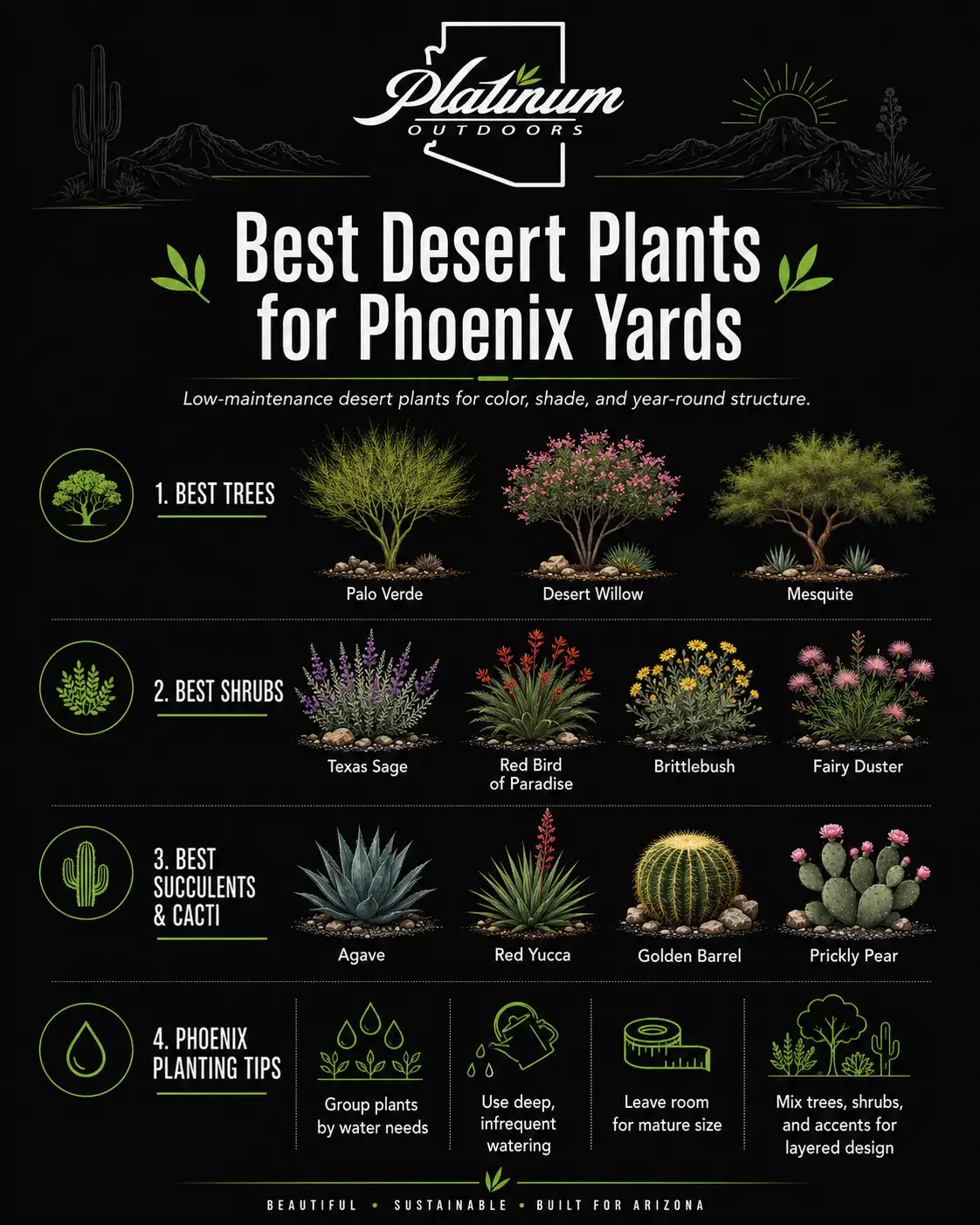
Some of the best options include palo verde, desert willow, Texas sage, brittlebush, fairy duster, red bird of paradise, creosote, jojoba, red yucca, angelita daisy, desert marigold, agave, golden barrel cactus, and prickly pear. The best selection for a specific yard depends on sunlight, available space, drainage, irrigation, and proximity to walkways or outdoor living areas.
What are the lowest-maintenance plants for Arizona?
Established native and desert-adapted plants such as creosote, brittlebush, jojoba, red yucca, desert spoon, certain agaves, and many native cacti can require relatively little routine care when planted in appropriate locations. Mature size and placement matter as much as species. A low-maintenance plant installed in a space that is too small may require frequent pruning.
Which desert plants provide year-round color?
Year-round color is best achieved by combining evergreen foliage with plants that bloom in different seasons. Texas sage, jojoba, creosote, little leaf cordia, red yucca, aloe, angelita daisy, red bird of paradise, penstemon, and desert marigold can contribute color at different times. No single plant needs to carry the entire landscape throughout the year.
What desert flowers attract hummingbirds?
Hummingbird-friendly options include red bird of paradise, fairy duster, chuparosa, penstemon, red yucca, Mexican honeysuckle, desert willow, and some aloe varieties. Grouping several nectar-producing plants with different bloom seasons can provide a longer period of interest.
What plants attract butterflies in Phoenix?
Desert milkweed can support monarch butterflies, while lantana, fairy duster, desert marigold, and other nectar-producing flowers may attract adult butterflies. Avoiding unnecessary pesticide use and providing a variety of bloom types can make the yard more supportive of pollinators.
What plants can survive full afternoon sun in Arizona?
Palo verde, mesquite, Texas sage, brittlebush, creosote, red bird of paradise, red yucca, desert spoon, golden barrel cactus, prickly pear, angelita daisy, and desert marigold are commonly used in sunny locations. However, newly planted specimens still need establishment watering, and reflected heat beside west-facing walls can be more intense than ordinary full sun.
What plants grow well in Arizona shade?
Mexican honeysuckle, chuparosa, coral fountain, selected aloes, Arizona rosewood, and certain agaves can perform in partial or filtered shade. The amount of available light affects flowering, growth, and watering needs. Deep shade beneath a roof overhang differs from filtered shade beneath a palo verde canopy.
How often should desert plants be watered?
Watering frequency depends on the plant, season, soil, exposure, and stage of establishment. Newly planted trees and shrubs generally need more frequent watering while roots develop. Established desert plants typically respond better to deep, less frequent irrigation than shallow daily watering. Cactus and succulents should usually be separated from plants that need more regular moisture.
When is the best time to plant desert plants in Phoenix?
Fall is often a favorable planting period because temperatures are lower while the soil remains warm enough for root development. Early spring can also work well. Planting during the hottest portion of summer increases stress and requires more careful irrigation management. Cold-sensitive plants should be timed with winter conditions in mind.
Do desert plants need fertilizer?
Many native and desert-adapted plants need little supplemental fertilizer. Excessive fertilization can produce rapid, weak growth and increase pruning needs. Plant health is often influenced more by correct watering, drainage, sunlight, and spacing than by routine feeding.
Are all desert plants safe around pools?
No. Thorny or rigid plants may create hazards near pool entries, narrow deck areas, and frequently used paths. Trees and shrubs that produce heavy litter can also increase pool maintenance. Poolside planting should favor appropriate scale, manageable litter, noninvasive roots, and safe clearance from circulation areas.
Can desert plants be installed next to artificial turf?
Yes, but the design should include edging, separate irrigation, and adequate room for mature growth. Trees should be positioned with future canopy, roots, and litter in mind. Planting beds can soften the edge of artificial turf and create a more natural transition into the surrounding landscape.
Can desert plants reduce water use?
Desert-adapted plants generally require less supplemental irrigation after establishment than a traditional cool-season lawn or high-water ornamental planting. Actual savings depend on plant selection, irrigation efficiency, yard size, maintenance practices, and the landscape being replaced.
What desert plants are best for privacy?
Jojoba, hopseed bush, Arizona rosewood, Texas sage, and selected desert trees can contribute to privacy screening. The best option depends on the required height, width, sunlight, HOA rules, and available planting depth. A mixed screen often looks more natural than a single tightly sheared hedge.
What desert plants should not be placed near walkways?
Large agaves, desert spoon, cholla, prickly pear, and heavily spined cacti should be kept away from narrow paths, gates, seating areas, and play spaces. These plants can still be used effectively as focal points in open beds where people and pets are unlikely to brush against them.
How much planning is needed for planting, irrigation, patios, and lighting in one landscape design?
These elements should ideally be planned together before construction begins. Patio dimensions influence planting space. Tree placement affects shade and lighting. Irrigation lines may need to pass beneath hardscape sleeves. Outdoor lighting requires fixture locations and wiring routes. Coordinating everything in a single design reduces conflicts and creates a more cohesive yard.
Are native Arizona plants always better than adapted plants?
Native plants offer important benefits, including regional character, wildlife value, and adaptation to local conditions. Desert-adapted plants from other arid regions can also perform well and expand the available range of colors, forms, and bloom seasons. A successful Phoenix landscape may use both, provided each plant fits the site and irrigation plan.
How can I make a desert yard feel lush without using much water?
Use layered planting rather than widely scattered specimens. Combine a shade tree, medium shrubs, flowering perennials, and groundcovers so plant canopies visually overlap at maturity. Select contrasting foliage colors and textures, concentrate flowers near outdoor living areas, and use hardscape as a framework rather than the dominant surface.
Creating a Desert Landscape That Fits Your Yard
The best desert plants for Phoenix yards are not simply the toughest plants available. They are the plants that fit the site, mature to an appropriate size, support the intended use of the yard, and work together as a coherent landscape.
A successful planting plan may combine palo verde for filtered shade, Texas sage for evergreen structure, red bird of paradise for warm-season flowers, red yucca for vertical bloom stalks, angelita daisy for low color, and agave or golden barrel cactus for sculptural contrast. Another yard may need desert willow, jojoba screening, Mexican honeysuckle in filtered shade, and a limited cactus palette kept away from circulation areas.
The right combination depends on the home, HOA, exposure, irrigation, hardscape, maintenance preferences, and outdoor priorities. Planning these elements together creates a yard that feels connected to the Arizona environment while remaining comfortable and usable for everyday life.
By choosing climate-appropriate plants, grouping them according to water needs, and allowing room for mature growth, Phoenix homeowners can create landscapes with color, shade, habitat, and structure without relying on a high-maintenance lawn.